

Teaching Resources
IV. Put the Issues to the Test With a Classroom Mock Trial
V. Teaching American Constitutional History

I. Why teach Kids the Law?
It’s essential. The law shapes how we live. It establishes our rights. It determines what kind of country we will have. The law is always changing.
The law leads studentfs to think about difficult questions, formulate arguments, defend their position, and see all sides of an issue.
II. Ask Hard Questions
When my son was three, he asked me, “Does God love the bad guys?” He was already grappling with questions of morality. Another time, he asked me, “Is today tomorrow?” There he was, at the age of three, trying to understand the mysteries of time.
Kids often ask hard questions, so we can ask them hard questions. This is good because the law lends itself to hard questions.
Constitutional law asks, among other things: What are our rights as citizens or residents of the United States? What are the limits of those rights?

Criminal law presents some of the most interesting issues in the law. Not everything bad can be a crime, so how do we decide which behavior to criminalize? How should we determine punishments? Does punishment work?

I agree with E.B. White, who famously said, “Anyone who writes down to children is simply wasting his time. You have to write up, not down. Children are demanding.” He also said, “I throw them hard words, and they backhand them over the net.”
III. It’s All About the Story
Legal cases and fiction have a lot in common.
- Fiction has characters, conflict, and resolution.
- Legal cases also have characters, conflict, and resolution (someone wins).
Legal cases begin with an argument. Two sides are in dispute. On both sides are people, and each thinks they’re right.
Legal cases essentially offer competing versions of the same story. When I handled appeals for people who had been convicted, part of my job was to tell their story. The prosecutors always saw the same facts differently.
When you change the viewpoint character, you have a different story.
Good fiction, like any good metaphor, stands for something greater than itself. Legal cases also stand for something larger than the dispute. Brown v. Board of Education, for example, stands for the idea that separate can never be equal.
IV. Put the Issues to the Test with a Classroom Mock Trial
My stepdaughter, Sabrina, was in fifth grade when I was in my third year of law school. She attended my moot court competition. Later, her teacher took me aside. “There was an argument on the playground,” her teacher told me, “and Sabrina organized a playground trial to settle the argument.”
We all know better than to underestimate kids and what they can do.
Here is the beauty of a classroom mock trial: No matter how much AI your students use to prepare, they will have to understand the issues thoroughly and think on their feet.
★ For ideas and guidance on how to conduct a mock classroom trial, click here.

★ For a guide to teaching Rebels, Robbers, and Radicals, click here.
★ For a guide to teaching Guilty? click here.
V. Teaching American Constitutional History
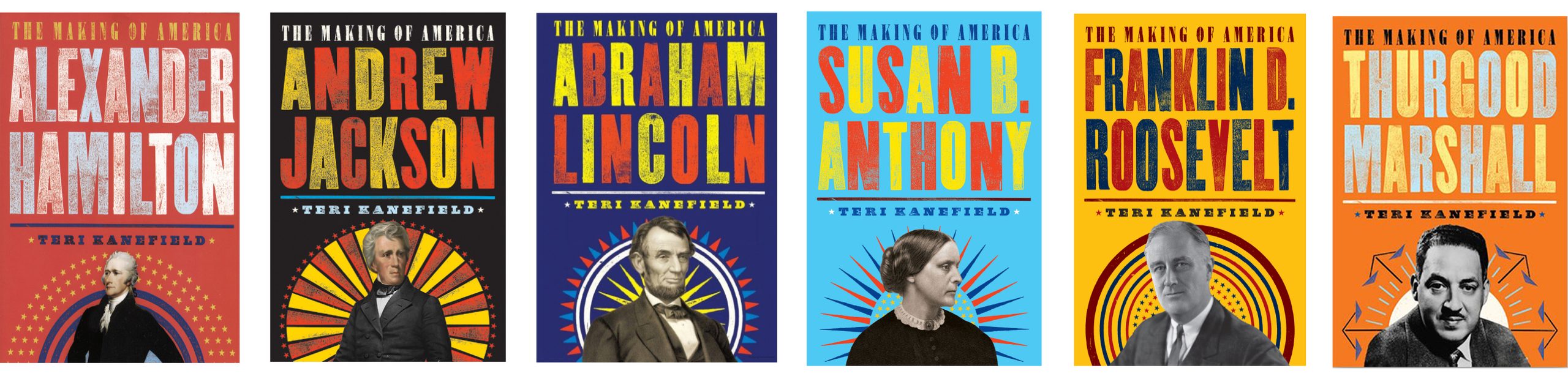
Much of American constitutional history consists of an ongoing debate over who should be included in “We the People.”
A. Shouldn’t Democracy Include Everyone?
The word “democracy” comes from the ancient Greek word “demos,” which means “people,” and “kratia,” which means “power.” Democracy, quite simply, means that the people rule themselves. Every democracy, though, excludes some people. No democracy, for example, allows a five-year-old child to vote. The ancient Greeks and Romans, who invented the idea of a democratic government, assumed that power would remain in the hands of free men.
One rationale for limiting political power to those who owned land was offered by the jurist William Blackstone, who, in 1769 in Commentaries on the Laws of England, wrote that voters without property were too dependent on others to have “will of their own.” He argued that this meant they would be too easily manipulated by those upon whom they were dependent, which “would give a great, an artful, or a wealthy man, a larger share in elections than is consistent with general liberty.”
Did you know that neither the original Constitution as written nor the Bill of Rights contains a right to vote? The founders discussed the matter but elected not to include the right to vote. It appears that the issue was too difficult to tackle.
James Madison observed that the right to vote was a fundamental right in democratic constitutions. He also observed that regulating the right to vote “is a task of peculiar delicacy.”
John Adams said, “It is certain in theory, that the only moral foundation of government is the consent of the people. But to what an extent shall we carry this principle?” He went on to say that even just opening the possibility of extending the vote and thereby giving political power to those beyond property-owning men was problematic because:
There will be no end of it. New claims will arise. Women will demand a vote. Lads from 12 to 21 will think their rights not enough attended to, and every man, who has not a farthing, will demand an equal voice with any other in all acts of state. It tends to confound and destroy all distinctions, and prostrate all ranks, to one common level.
Notice the phrases “destroy all distinctions” and put everyone on “one common level.” Adams didn’t think people were on a common level. He—and the majority of the other founders—believed that some people, perhaps because of their education or position in society, were better equipped to make decisions affecting the entire nation.
The founders ducked the problem by leaving it up to each state to decide who should be included within its own borders. Essentially, they kicked the problem down the road. Alexander Hamilton, when speaking about the issue of slavery, said, “without this indulgence no union could possibly have been formed.” In other words, raising thorny issues would have most likely made a union impossible.
B. The Making of America Traces the Question of Who Should Be Included

Alexander Hamilton: When the nation was born and the Constitution was ratified, power rested in the hands of white, well-educated, mostly land-owning men.

Andrew Jackson: Jacksonian democracy meant that all white men should have an equal voice.

Abraham Lincoln: At the conclusion of the Civil War, Black men were included—well, at least in theory.

Susan B. Anthony: As a result of her work and the work of her associates, white women were included. (There is a widely repeated claim that Susan B. Anthony deliberately left out Black women. In this biography, among other things, I trace precisely what happened using original sources.)

Franklin Delano Roosevelt: On the theory that too much income inequality puts too much power into the hands of a wealthy few, Roosevelt gave us the New Deal, which in turn gave Americans their first true middle class. Because of backlashes after the Civil War, Black Americans, however, were still not included.

Thurgood Marshall: As a result of the work of Thurgood Marshall and others, Black Americans were able to participate in American life and government.
C. The Biographies Overlap, Creating a Coherent Story from the Founding to the Present
Andrew Jackson makes a brief appearance at the end of Alexander Hamilton. Susan B. Anthony was born before the Civil War. Each of these biographies overlaps with the one before and after to create a coherent story of American constitutional history.
D. The Making of America Series Does Not Shy Away From Difficult Topics
In 2016, when I sent the completed manuscript of Alexander Hamilton to my publisher, the first response I received was surprise. “But Teri, your book includes economic theories and methods of constitutional interpretation!”
Me: “So?”
The response: “But this is for kids.” I presented my argument: You can’t understand Hamilton without economic theories and methods of constitutional interpretation. I suggested putting the hard concepts in text boxes. My editor confirmed with the production team that it could be done. That’s where you’ll find the difficult concepts.