Back before law school when I was a college English instructor, I taught a course in children’s literature, which inspired me to try to write children’s stories. My first published book (Cricket Books, 2001) was a middle-grade novel, Rivka’s Way.

Before I tell you how I became a writer of children’s soccer stories, I must tell you that when I started this venture, I knew almost nothing about soccer. When our kids played soccer, I sat with the parents and tried to make sure I cheered at the correct times, but (to be honest) I wasn’t always sure what was happening.
The author of the popular Boxcar Children series, Gertrude Chandler Warner, died in 1972. But she kept writing and publishing children’s books! How did she do that!?
Well, her publisher wanted to keep the popular series alive, so they hired authors to ghostwrite the stories. I suspect the sale of the Boxcar stories helped keep the publishing house afloat. I thought what the heck and wrote this one. Under the terms of the contract, I can say that I wrote it—but the only evidence is my contract (here’s a snippet).
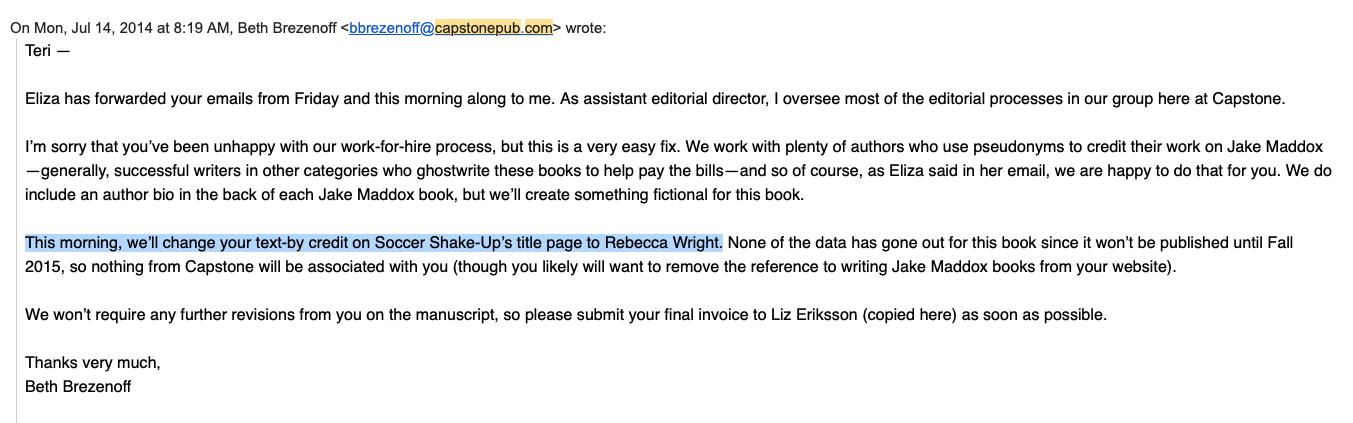
I guess it’s easy for writers to get pigeonholed. I was evidently now a writer of children’s stories about soccer because the publishers of the books by Jake Maddox (there is no such person as Jake Maddox) asked me to write a soccer story for their series. So I wrote this one. Under the terms of the contract, my name would go on the copyright page, but the editors would have the final say on editing. I disagreed with the editing choices. Rather than spending too much time arguing (which was pointless after they pointed out that the contract allowed them to do what they pleased) I asked that the publishers use a pseudonym for me on the title page.
After all that practice writing soccer stories, I figured I may as well write another.

This time I hired my own editor and cover designer so I could do it the way I wanted.
Would it be catty to point out that the reviews for Michael’s Mighty Kick are better than the reader reviews for my Jake Maddox book?
Other Children’s Stories
Next, I wrote a short story called “The Mystery of Sound” and sent it to Cricket Magazine. It was published in the April 2013 issue.

You can read it here.
I wrote another short story, this one about a dog who thought his name was Look Here:

From a Goodreads reviewer:
You can read it here.

Writing children’s stories was such a fun break from the emotionally difficult work I did as an appellate lawyer that I kept writing them. When dystopian novels were all the rage, I figured I should write a utopian novel. I can be contrary that way. I wrote a series about a group of teenagers (the high school chess team that calls itself Knights of the Square Table) who get stranded on an island and figure out how to create a better world.
When I received this from a reader, I knew the effort of writing the series had been worth it:


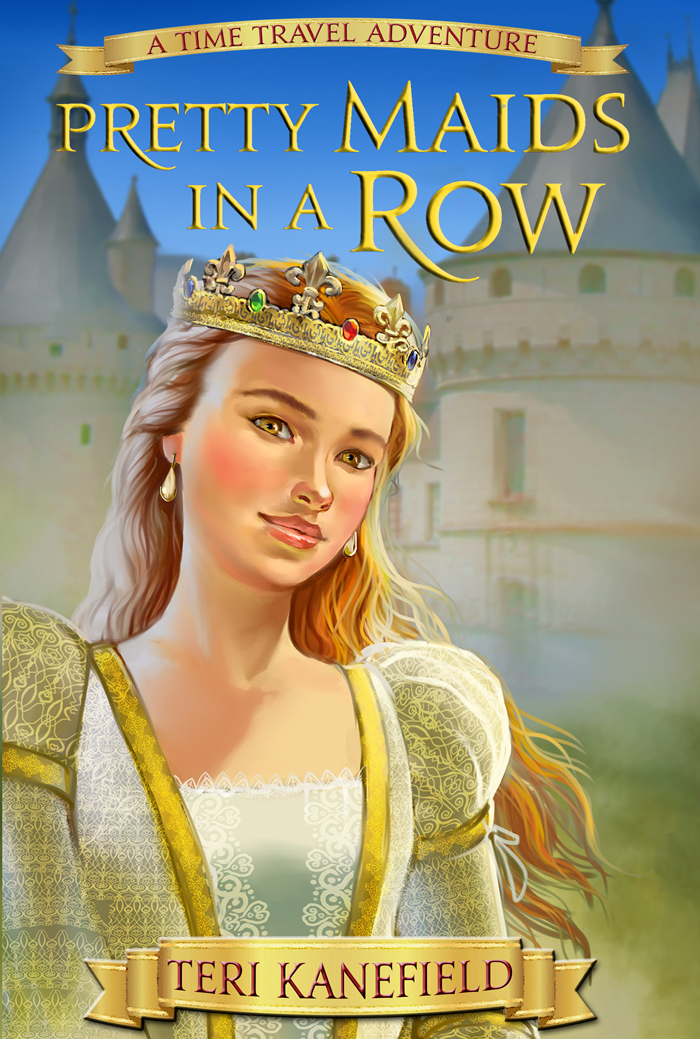
As a child, I was fascinated by biographies of Mary Queen of Scots. I liked reading about powerful women in the past, and when I was growing up in the 1960s, there were not many examples of women with political power.

Here is the description of Pretty Maids in a Row:
Mattie, a girl from Los Angeles, learns how it feels to walk in the shoes of Mary Queen of Scots. She discovers that being the pampered darling of the French court isn’t all it’s cracked up to be. While being kissed by a real prince has a certain appeal, and turning down the marriage proposal of a king can give a girl confidence, a young queen who does not learn to distinguish flattery from true friendship is bound to come to a tragic end.
Then I thought I’d try writing a mystery.
 From a 10-year-old reader:
Main character Rebecca has to prove her soon-to-be stepmother is innocent of stealing. She takes the time and the clues she was given to solve the crime. I liked the fact it always gives you certain clues but still have no idea what is going to happen. There is nothing boring about it! The plot keeps you turning the pages to find what’s next.
How I Became a Writer of Nonfiction Books for Young Readers
In my legal work, I came across the story of Barbara Johns, a sixteen-year-old plaintiff in Brown v. Board of Education, who should have been credited with starting the modern Civil Rights movement. Because I had experience writing fiction, I pitched a historical novel based on Barbara’s life to an editor at Abrams. The editor told me that if I was willing to write the book as non-fiction, he’d offer a contract. I agreed to write the book as nonfiction.
I then went on to write eight more nonfiction books for Abrams, including a 6-book series called The Making of America. Houghton Mifflin published my book on criminal law aimed at ninth graders, Guilty: Crime, Punishment, and the Changing Face of Justice.
So here I am, the author of 16 books for young readers and 2 children’s short stories.