The Power of Lies:
Are we Creating our own Noise?
On Saturday, June 20, 2026, I gave two talks in Madison, Wisconsin. Because audience questions took me in different directions, each covered slightly different ground. Also, I prepared more material than I had time to present. But it’s all here, including a few questions from the audience.
I. The Ancient Art of Using Lies to Consolidate Power
(Most of this section is taken from A Firehose of Falsehood, which is where you can find the sources.)
 We can start with Darius the Great of Persia (522 BCE to 486 BCE), who carved what is now called the Behistun Inscription into the face of a cliff. The inscription tells the story of how he came to power. If we believe the story, his kingdom was given to him by the supreme god Ahura Mazda, he defeated 19 armies in a single year, he overthrew nine kings, and he never lost a battle.
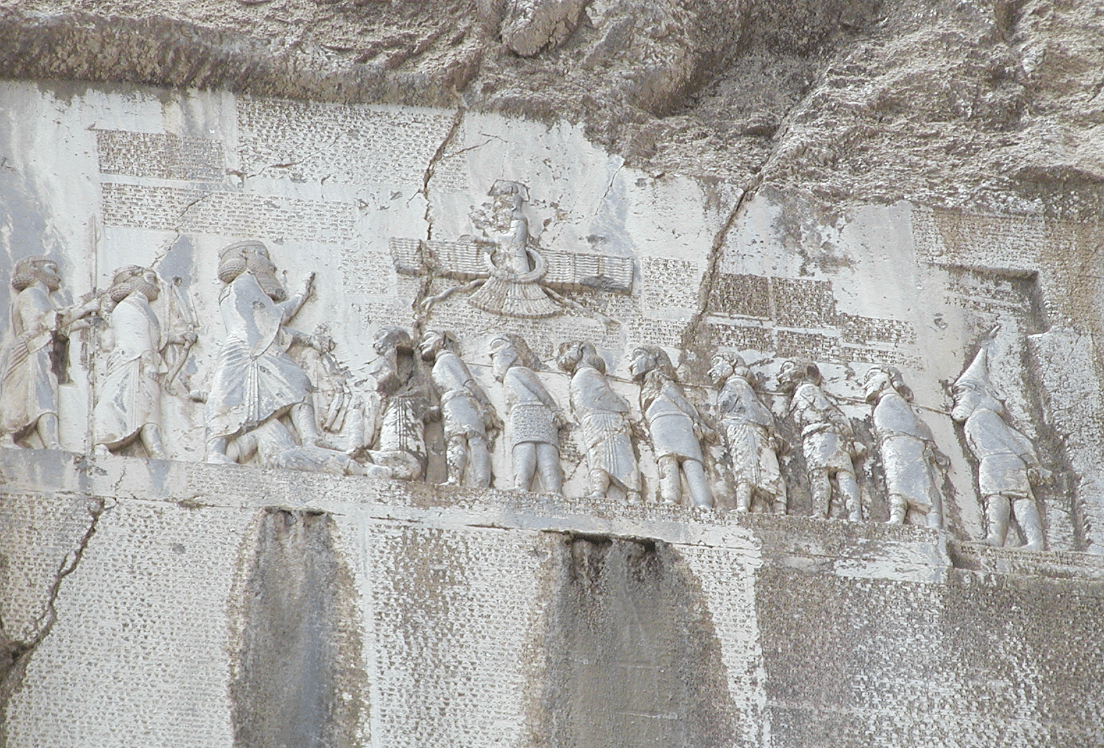
His inscription includes this warning: “Anyone who rebels against me, I will destroy. Anyone who supports me, I will protect.” Twenty-five hundred years ago, an enormous inscription on the face of a cliff was impressive. Only someone great and powerful could have ordered such an inscription to be created.
Darius’s inscription is included in the genre of literature called Naru literature, or pseudo-autobiography. These kinds of stories recount the legendary heroic feats of the ruler, and they follow a particular pattern: They are told in the first person and tell larger-than-life stories. The stories are intended to solidify the ruler’s power by impressing supporters and intimidating enemies.
Now I’ll give you an example of a more modern pseudo-biography. Here is how Benito Mussolini told the story of how he came to power (I’m paraphrasing from his speeches):
Before I took control, Italy was in disarray! Inflation and unemployment were rampant! The weak and ineffectual socialists were running the country into the ground.
The people of Italy thirsted for direction and order!
I alone could restore order and glory to Italy. For two days, from October 28 until October 30, 1922, a great army, sprung from the people, marched, and gathered strength.
After marching for two days and conquering all of central Italy, this mighty army marched into Rome to restore order and put Italy on the first step toward redeeming our lost glory.
I rode into Rome on horseback at the head of a mighty army!
I entered the palace and demanded that the weak and ineffectual king turn over the leadership to the men and women of Italy, to the people!
Good story, right? Here is what really happened:
Mussolini had a royal summons to meet with the king. Before his appointment, he and his supporters published a fabulous and untrue story (in a newspaper they controlled) about how central Italy was occupied by the blackshirts.
On the day of the scheduled meeting, Mussolini rode an ordinary passenger train to Rome. He met with a mob of his supporters outside the palace. Then he respectfully entered the palace and met with the king, who appointed Mussolini prime minister and gave him permission to try to put together a majority coalition.
Mussolini’s version was widely believed. In fact, Hitler believed it, and tried to do the same thing. He and his mob tried to take control of the Bavarian government by force. He was arrested, ended up in prison, and that’s when he wrote Mein Kampf.
In Mein Kampf, Hitler discusses what he calls the “big lie.” He said that in a big lie there is always a certain force of credibility. Because people often tell small lies, they are prepared for those. It would never come into the heads of most people to fabricate a colossal untruth or a large-scale falsehood. Therefore, they don’t think others will do so.
So basically, Hitler wrote a propaganda manual while he was in jail for an act he committed because he believed Mussolini’s lie about his March on Rome.
Now I’ll offer a purely hypothetical example of pseudo-biography suitable to our global economy which produces billionaires (and now trillionaires):
I am a billionaire because I am the greatest and most brilliant businesswoman who ever lived. I started with almost nothing and, using my own cleverness and ingenuity, I built a global financial empire. There was no luck involved. As evidence of my greatness, you can see my name in shiny gold letters up on that building (that would be the modern equivalent of the ancient Behistun Inscription.)
Remember that was a purely hypothetical example. I am not picking on anyone.
Now I want to call your attention back to something Mussolini recognized: Democracy is disordered. It’s messy. Autocracy, in contrast, is ordered.
Mussolini also recognized that there are people who thirst for order and dislike chaos. I have often quoted psychologists who study what they call the authoritarian personality. People with this personality type want order. They prefer sameness. They are uncomfortable with differences. (For more, see the section on the Authoritarian Personality here. Dr. Karen Stenner’s research also shows that about a third of the population across cultures has this personality type, and the authoritarian personality exists on both sides of the political spectrum.)
An early 20th century Russian philosopher named Ivan Ilyin was one of those thinkers who disliked democracy. He believed the Bolshevik Revolution was a disaster, and he didn’t think democracy could work. He thought democracy was too disordered and messy, partly because the lower and middle classes are always striving for advancement.
Because Ilyin hated communism and distrusted democracy, he was an early defender of Hitler. He believed that Hitler, like Mussolini, represented a better form of government, one which was ordered. He believed the entire nation should move and think as one. The nation, he said, is like a body, and the citizens are parts of the body. Each should remain in its place. The head stays at the top. The feet stay below.
The best form of government, in Ilyn’s opinion, has a strong leader who keeps order. The leaders must keep everyone else in line. How do they do that? Not by giving the people too much, because if they do that, the people will start wanting to become the heads. So good leaders don’t do things like provide health care or public education. Instead, they keep the people psychologically captivated by telling them enthralling stories.
A good leader, therefore, puts on a good show. He tells fabulous lies to keep people psychologically captivated.
One way to do that is identify an enemy, blame all the problems on the enemy, and promise to protect the people by destroying the enemy. It’s an age-old formula. That’s why, in George Orwell’s 1984, Oceana is always at war.
It’s not a good idea, though, to have a real war with an enemy who has power. Things can go wrong. If you start a real war with a powerful enemy, you might lose. You might even be killed.
In 1984, there is no danger of losing the war because the actual threat is nonexistent. The war is designed to distract the citizens with make-believe enemies. It was spectacle and pretend crises.
It’s always safer to identify an enemy that has no power and can’t fight back, for example, a poor homeless migrant family fleeing a wartorn country. The leader then says: “Your suffering is all because of the evil migrants who are coming to take your jobs and everything that belongs to you.” Or: “It’s all the fault of the Muslims.” Or “It’s the fault of the evil Jews.”
That way, the leaders can easily defeat the “enemy” and enthrall the people with crises without risk to themselves.
Question from the audience: Do the people want stories?
Yes.
Stories are satisfying and help us make sense of a complicated world. In fact, evolutionary biologists tell us that our brains evolved to survive, and one way to survive is to organize lived experience into stories.
At its best, good literature teaches us about ourselves and helps us make sense of our experiences. Myths present a kind of truth through metaphor. Almost every known culture has stories explaining where we came from and our place in the universe.
But that same biological hunger for narrative is precisely what makes us so vulnerable to manipulation. Because our brains evolved to survive, we don’t just crave comforting stories—we respond instantly to terrifying ones.
Invented stories can feel true if they speak to deeply rooted fears. Evolutionary biologists tell us that for almost all of human history–roughly 95% to 99%–humans lived in small bands and survived as foragers. It was only about 12,000 years ago that humans began domesticating plants and animals. Foragers lived in fear that neighboring bands, or predatory animals, would come steal resources and threaten their territory. Therefore, the story that “those foreigners are coming to take what is yours” resonates.
At the same time, scientific facts can seem counterintuitive and therefore wrong. For example, “If you jab yourself with this needle, you may get sick, but it’s good for you” makes no sense in a forager’s worldview in which the goal was to prevent sharp foreign objects from penetrating our bodies.
It’s a lot easier to believe that those foreigners who look and act differently pose a danger.
Here is another way to look at fabulous lies. Democracy, which literally means “rule by the people,” requires that people have access to accurate information. You can’t make governing decisions without facts. So, a would-be autocrat seeks to make it impossible for people to have accurate information. Keeping people distracted and enthralled with fabulous stories is a way to drown out and subvert the facts.
The Firehose of Falsehood is the name of a technique for subverting facts. Instead of relying on a big lie, The Firehose of Falsehood method requires that the propagandist unleashes a rapid and continuous stream of small lies that overwhelm the listeners. For it to work, the propagandist has to be willing to lie shamelessly.
Vladimir Putin is a master at this. In 2014, when Russia invaded Crimea, he told reporters: “There are no Russian troops in Crimea.”
There were Russian troops in Crimea; everyone could see them. When journalists returned with photos of soldiers in Crimea wearing Russian uniforms, Putin said, “Those uniforms can be purchased in second-hand stores,” and “Those are fake images.”
Reporters were stunned. Their attention was captured by the spectacle of the audacious lies. Notice what was happening. Putin deliberately created a spectacle. People were talking about his outrageous lies instead of what the soldiers in Crimea were doing. And that’s what Putin wanted. He created theater.
You can see that the liar has an advantage. It’s easy to keep throwing out lies. But disproving each lie takes a lot of work. The fact-checkers can’t keep up. Eventually people get worn out. When your own government and media are engaged in this behavior, the people conclude that the truth is unknowable, and they give up trying to learn the truth. That’s when lies take over.
This raises an interesting question: When a leader tells outrageous lies, how do the supporters feel when they find out it’s a lie?
Philosopher Hannah Arendt, who understood people like Putin, said, “When the people find out it’s a lie, instead of deserting their lying leader, they admire the tactical cleverness of those lies.” They cheer the lies because the lies help them win.
A related technique for subverting facts is called “Censorship through noise.” Instead of shutting down dissenting voices, the would-be autocrat creates lots of noise to drown out the facts.
The famous “invisible gorilla” experiment illustrates how this works. Viewers are told to watch a video of students passing a basketball and they are told to count the passes. Meanwhile, a gorilla walks right through the action. More than half of the viewers were so focussed on the action that they didn’t see the gorilla, even though a gorilla passes right in front of their eyes.
There is only so much we can pay attention to, so unleashing a constant stream of crises and spectacle is a brilliantly simple way to torpedo facts.
Next, I’ll talk about how one country uses lies to gain advantage over another.
As always, the methods are not new. The first written manual describing how to deploy lies to control other countries, The Arthashastra, was written in Sanskrit 2,300 years ago. The author is believed to be a minister named Kautilya who served Chandragupta, the founder of the ancient Mauryan Empire in India.
The Arthashastra explains that there are two kinds of wars, open wars and concealed wars. Open wars are fought on the battlefield. Everyone knows it’s happening. These are always risky. Even if you win the battle, you’re likely to suffer losses.
In a concealed war, on the other hand, you can entirely vanquish an enemy without suffering a single loss.
A concealed war is won by spreading lies that weaken the enemy. For example, the emperor can plant his own people in the enemy country, and after these people establish themselves as trustworthy, they begin spreading lies that undermine the authority of the enemy leaders and create chaos in the country.
The Soviets called this method Active Measures. Active Measures are carefully constructed false messages leaked into an opponent’s communication system designed to undermine the authority of the leaders and create chaos.
Here’s an example. In 1957, the Soviets forged a letter from American businessman Nelson Rockefeller to President Eisenhower outlining a plan to use the American military to manipulate foreign countries. The Soviets published the letter in an East German newspaper.
The fabricators of this lie didn’t think a Soviet-run newspaper had credibility in the west. Well, the story was picked up by three western newspapers, which gave the story credibility. The Soviets then circulated the western versions. Because a lot of people in the west believed the letter was genuine, the letter succeeded in creating confusion and discord, and undermined the credibility of a democratic government.
Here is something interesting and counter intuitive. Active measures are often designed to be overestimated, and sometimes, the propagandist wants to get caught. I’ll explain why using the example of Russian interference in the 2016 election.
During the years leading up to the 2016 election, a Russian agency called the Internet Research Agency carried out a social media campaign that favored Donald Trump and disparaged Hillary Clinton. Russian agents, posing as Americans, set up Facebook pages, and fooled lots of Americans, who thought they were interacting with other Americans.
For example, Russians created a Facebook page called The Army of Jesus. The target audience were white evangelical Christians. As always, the first step is to build trust in the target audience, which the Russians did by posting things like:
- “There has never been a day when people did not need to walk with Jesus.”
- “I’ve got Jesus in my soul.”
Trust-building works because of a thing called confirmation bias. Psychologists tell us that when people have their biases or beliefs confirmed, they feel good. They keep watching. They hit the follow button.
After attracting an audience and building trust, the agents deployed what they called “payload content.” Interspersed among the Biblical quotations, they posted things like, “Hillary Clinton wants to remove the mention of “God” from the Pledge of Allegiance.”
This page attracted about 200,000 Americans who apparently did not know they were interacting with Russian agents.
Russian agents also created a page posing as a Black activist group. This page generated 11.2 million engagements. (This is not the number of followers. This is the number of times users engaged with the postings in some way.) After building trust by persuading people that they were Black activists, the Russian operators interspersed messages like these:
- I won’t vote for Hillary Clinton
- Why should we even vote?
- A vote for Jill Stein is not a wasted vote.
Okay, so, here is why the Russian agents wanted to get caught and why Active Measures are designed to be overestimated: The goal wasn’t just to sway the election. The goal was to undermine democratic institutions and cause chaos and confusion. This is precisely what happened when Americans learned that the Russians had launched a campaign to sway the American election.
The Russians understood that if Trump won and the public learned that the Russians had helped him by fooling lots of Americans, a lot of people would conclude that Trump won because the Russians helped him.
You can see how diabolically clever this is. Nobody will ever know how much the Russians actually helped, but the social media campaign created confusion. A great many people, who had trouble believing Trump could win a national election, concluded that his presidency was illegitimate and that he won because Putin helped him.
The investigations and revelations about Russian methods created theater. Some of this information was given to the public in the form of indictments. For example, the Department of Justice indicted the Russian Internet Research Agency. This is known as a speaking indictment. The DOJ knew it would never bring a Russian agency to justice in the United States. The goal was to inform Americans about how easy it is to be fooled online.
Putin wanted Trump to win, and he wanted to create chaos by undermining the legitimacy of the election. He also wanted people to conclude that he is clever enough and powerful enough to manipulate an American election. Remember the warning: “If you are my foe, I will destroy you.”
II. Our Current Information Disruption
(Sources for this section can be found In How Extremism Happens, which you can read here, and A Firehose of Falsehood. Some also comes from the talk I offered to Madison area librarians in May. Some of this material is new.)
Our current information disruption is allowing lies and disinformation to be magnified and spread with unprecedented speed and scale.
“Disruption,” of course, is a negative word. We could also say “transformation.” The way we communicate is being transformed.
This transformation is affecting book publishing. It’s affecting news reporting. It’s changing how we communicate. I opened my first social media account about 15 years ago so I could see what our kids were doing. I learned to send text messages when that turned out to be the only way I could communicate with my son.
It is worth pausing to appreciate the enormity of this moment.
In all of human history, there have only been a few major transformations in how we communicate, and each one has enabled (or created) major changes in how people live.
The development of writing, for example, allowed knowledge to be stored outside the brain, which allowed for an accumulation of knowledge. Writing also transformed how people live. You can’t have a complex state or bureaucracy without written records, so—no surprise—the development of writing allowed for the emergence of states and bureaucracies. Laws could be codified.
Another major transformation was the invention of the printing press. Before the printing press, writing and disseminating information was difficult and expensive. As a result, written documents generally carried authority because they tended to be edicts from the king, or bureaucratic records, or church decrees.
Advances in technology often bring good things. The printing press, for example, made books and information available to more people. Literacy spread.
The printing press also flooded people with written material at a scale never before experienced—and people didn’t yet have tools to evaluate the sudden deluge of new sources.
While the printing press didn’t cause the Protestant Reformation, historians tell us the printing press was the most important driver of the Protestant Reformation by allowing reformist ideas to spread widely and quickly. The religious wars that resulted from the Reformation devastated much of Europe.
The internet, like the printing press, is bombarding people with written material from a proliferation of new sources — and people don’t yet have the tools to evaluate the information.
In my childhood and early adulthood, most people got their news once or twice daily, maybe from the morning newspaper or the evening news. There were only a handful of major news outlets. Television network news was funded by advertisements and subsidized by the networks’ popular TV shows. Because network news broadcasts were reaching large audiences and were dependent on advertisers, these outlets strived for neutrality. A Gallup poll in the 1960s showed that a whopping 85 percent of Americans got their news from one of three TV network news programs.
To my young ears, Walter Cronkite on the CBS Evening News sounded like blah blah blah. A neutral recitation of facts is often boring, but The CBS Evening News (which offered 22 minutes of actual news) routinely reached audiences of more than 30 million people each evening. When Cronkite saw the poll showing that 85 % of Americans got their news from one of the three major network news programs, he responded to what he understood was an enormous responsibility by tightening the broadcast to get more facts into his 22-minute presentation.
Among other things, this meant that the voting population generally started from the same set of facts. People might have different ideas about how to respond to the facts (what we can call ‘value responses’), but they started from the same facts about what was happening in the world.
Now, all that has changed.
The disruption to news reporting began with partisan cable news shows in the 1990s. Cable news started us on a 24-hour news cycle. There are rarely enough facts to fill hour after hour of programming. To fill time, these shows offer mostly opinion and analysis. They offer value responses.
Because cable news programs are funded by subscribers, they need loyal viewers. So, instead of trying to reach a wide audience by striving for neutrality, cable news shows did the opposite. They became openly partisan. To hook their viewers, they use all the ancient tricks. They confirm the biases of the audiences. When people have their biases confirmed, they trust the source. They keep watching. They hit the subscribe button. To keep people watching, cable news producers create conflict and drama. Cable news shows often feature panels of “experts” arguing about the news. These panels can be riveting. The panelists argue. They interrupt each other. They shake their fists. They pound the table. What sticks with viewers are the bias-confirming, emotionally charged eruptions.
It isn’t boring. In fact, it’s entertainment.
Is it crisis and spectacle?
Rage hooks people. On the Internet, it generates clicks. The Facebook whistleblower Francis Haugen, in her testimony before Congress, testified that Facebook algorithms incentivized angry, polarizing, divisive content because doing so increased engagement.
You can see that would-be autocrats are not the only ones who benefit from creating crises and spectacle. It also turns out to be profitable.
Now “news” sources are popping up everywhere. Anyone with a keyboard and access to the Internet can be a “news” source. These “news” sources, like so many cable news shows, do not break the news. They are not reporters. They read the news that someone else has broken and they offer value responses.
One of my pet peeves, by the way, is when social media influencers start a post with BREAKING and then repeat the news a real reporter broke.
I asked someone once what she does after work, and she said she watches Fox News. She didn’t watch the news. She watched a particular brand of news. Someone else might watch MSNBC and come away with an entirely different view of what is happening in the world.
Having different brands of the news should be an inherent contradiction.
Today, some people get their “news” from a few Facebook accounts. Others may get their “news” from a handful of Substack authors. Consider the economics. A Substack account with only 5,000 subscribers paying $5 a month can gross $300,000 in a year. So, all you need is 5,000 subscribers to make a killing.
Compare today’s fragmented news audiences to the Walter Cronkite era.
Question from the audience: Would bringing back the Fairness Act help?
Short answer: No.
The Fairness Act was a federal communications regulation enacted in 1949 and repealed under the Reagan administration. The Fairness Act required that commercial television and radio stations always present both sides of an issue. The federal government only had jurisdiction over AM and FM radio stations and over-the-air television stations. The Doctrine was repealed on First Amendment grounds. The idea was that the federal government should not be telling media outlets what could do or say.
Almost immediately after the Fairness Doctrine was abolished, Rush Limbaugh launched his highly partisan and controversial radio station. It’s easy to think one event caused the other, and perhaps it did, but the Internet happened independently and created an abundance of online news outlets out of reach of the federal government.
Also imagine the federal government telling Rachel Maddow that she has to be fair to Trump, and if she isn’t, she will be faced with huge fines.
Really, though, it’s a good question because of the timing: The Reagan Administration repealed the Fairness Act, we got Rush Limbaugh, and here we are. When I first wrote A Firehose of Falsehood, I wondered if bringing back the Fairness Act would help but then concluded that the Fairness Act would not solve the problems we have now.
Sometimes the problem is a matter of fact selection. If the Fox-viewing group is hyperfocused on one set of facts, and the MSNBC crowd is hyperfocused on a different set of facts, each will have an entirely different view of what is happening and which problems are most urgent.
Another problem is the sheer complexity of our world. What if, as evolutionary psychologists suggest, the way our brains are wired makes it hard to comprehend something like globalism? What if, in evolutionary terms, we are still villagers, or maybe even foragers, with brains wired to respond to our immediate environment?
Let’s go back in time. Suppose a band of early sapiens is out foraging for food. One communicates to the others that there are large predator cats up on the cliffs. The others can verify with their own eyes that they are indeed surrounded by predators. Different members of the group may have different ideas about how to respond, but everyone can see the cats.
Now, what happens (1) you don’t personally know the source of the information and (2) when the danger is something you can’t see, maybe because it’s on the other side of the planet, or maybe because seeing it requires complex laboratory equipment, or maybe, because something as complex as globalism can’t be viewed with our own eyes.
In the Disney movie, Coco, the boy, Miguel, says, “I thought it was one of those lies adults tell kids, like vitamins.” One of the adults says, “Vitamins are real, Miguel.” Vitamins sound like a good story for tricking kids. “You’d better be a good boy or Santa won’t come. You must eat vegetables and not ice cream because vegetables have vitamins.”
I recently read In Search of Memory, by a Nobel prize-winning scientist Eric Kandel, and I want you to know that I believe neurons are real, even though I’ve never seen one, and I believe neuroscientists are making discoveries that offer new answers to the ancient questions of, say, “Is there a separation of mind and body?” I believe neurons are real, but I see the problem. When a neuroscientist tells me that the feeling I have that I have a mental existence apart from my body comes from electronic impulses in my brain, well, I can see why so many people find it easy to dismiss science.
How do you wrap your brain around the fact that what you think is happening in your brain isn’t what you think is happening?
We are asking people to believe in the existence of things they can’t see — like antigens, neurons, and greenhouse gases. What makes this particularly tricky is that the things we are asking them to believe are often directly contrary to what they are taught by other authorities in their lives, including religious leaders.
The Internet does more than allow bad information to spread with unprecedented speed and scale. Algorithms allow like-minded people to find each other, creating what have been called ideological filter bubbles. Within these bubbles, which can consist of hundreds of thousands or even millions of people, like-minded people confirm each other’s biases and pummel each other with carefully selected rage-inducing information, thereby pushing each other deeper into extremist thinking.
The term “filter bubble” was first coined by Eli Pariser in his 2011 book, The Filter Bubble: What the Internet Is Hiding from You. He showed that when a person searches for information online, algorithms show users personalized content based on their online behavior, such as search history, location, and past clicks. That means users are shown information that aligns with their existing beliefs and interests, thereby reinforcing those views. This is getting worse as artificial intelligence gets better at telling people what they want to hear and confirming their biases.
In the old days, when you opened a paper newspaper, you could see at a glance which articles were factual news reporting, and which were editorials and analysis. Today, people online tend to scroll through headlines. The problem is that editorials, value responses, and analysis are intermingled with factual reporting — and most of what we see on line are value responses. I was writing legal commentary for The Washington Post when I realized what was happening. When my piece appeared in the Sunday paper, you could see it was analysis. It was a value response. But on the internet, the headlines (which I didn’t write) looked exactly like news headlines. I could see that facts and opinions were intermingled, making it difficult to tell them apart.
I suspect AI will make things worse if people rely on AI bots to filter information, the way they now rely on algorithms, and those AI bots are manipulated to steer people toward a particular world view. In comparison, the methods imagined in Orwell’s 1984 for controlling what people thought seem almost primitive.
As I said with the printing press, advances in technology can bring good things. They can also wreak havoc.
Are we flooding our own zone? Are we creating our own censorship through noise? Are we burying the facts amid an avalanche of spin and opinion?
Our task is to make sure that our technology does not outpace our wisdom to manage it.