
Chapter 1
Demagogues and Artists
In September 2024, I went to Chile for the national independence festivities and a family reunion for my husband and his siblings. While there, I learned something that surprised me. One of my in-laws—she’s 84 and one of the sweetest people I know—admires Augusto Pinochet. She was firm in her views. I was warned not to talk politics with her, so I didn’t. But I talked to others who knew her opinions.
I asked, “Does she know that Pinochet staged a military coup? Does she know he overthrew a legitimately elected president? Does she know he installed himself as a brutal dictator?”
The answer: “Yes, she knows all that. But she says he saved Chile from communism.”
This was a woman who worked her entire life as a baker. She never had much money. I struggled to reconcile her economic status and sweet disposition with her support for a brutal dictator.
To make sense of it, I dug deeper into Chilean history.
This is what I learned: Before the troubles began, Chileans prided themselves on having the most stable democracy in South America. Chile also had a high level of income inequality. Then, in 1970, Salvador Allende, co-founder of Chile’s Socialist Party, was elected president. After he was inaugurated, he set to work restructuring Chilean society along socialist lines. To address the extreme income inequality, his government authorized large wage increases and froze prices. The government acquired significant privately owned mining and manufacturing assets and took control of large agricultural estates for use by farming cooperatives. Allende’s government deducted what it called “excess profits” from compensation owed to US copper companies when nationalizing them.
The Nixon Administration was furious. Foreign investors lost confidence in Chile. The Chilean economy took a dive.
A shortage of basic commodities created a black market. Sporadic violence from the far left continued under Allende, contributing to the polarization and anxiety. People were braced for trouble.
Trouble indeed came. Hardliners opposed to Allende accused him of attempting to “implement totalitarianism in Chile.” Allende sought to appease his supporters by pushing harder against his opponents. Chile was in crisis. In the words of Harvard political science professors Steven Levitsky and Daniel Ziblatt, “mutual tolerance disappeared,” and instead of compromising, politicians “tried to win at all costs.”
Their point is that democracy requires compromise. It requires give and take. It requires people working together. It requires mutual tolerance. When all that mattered was winning, in the words of Ziblatt and Levitsky, “Chileans, who had long prided themselves on being South America’s most stable democracy, succumbed to dictatorship.”
On September 11, 1973—with US help—Pinochet staged a coup. Tanks rolled into Santiago, and fighter jets bombed the presidential palace. Allende was overthrown.
Pinochet dismantled Allende’s reforms, installed himself as dictator, and held power for nearly twenty years. During that time, roughly 28,000 people were arrested for opposing him. Many were tortured or imprisoned. Roughly 3,200 people who opposed him were executed or disappeared.
Pinochet’s supporters argued that he responded to a crisis and did what was necessary. They say he was saving the Constitution. I could find no credible source that claimed Pinochet followed the law. He was, according to his defenders, using illegal—and brutal—means to save the Constitution. In the words of Robert Packenham and historian William Ratliff, writing for the Hoover Institution, Pinochet—who they refer to as a “strongman”—ruled harshly but “left behind the most successful country in Latin America.”
Pinochet’s power waned in 1988, when he lost a plebiscite. 55 percent voted against extending his rule, while 44 percent still supported him, a reminder that dictators often have real public support.
Today, Chile is a representative, constitutional democracy with a high level of income inequality, which many activists still want to address.
In a 2015 interview, Chilean American poet Marjorie Agosín said, “I think Pinochet has been proven to be an evil dictator in the eyes of most people in the world, and most people see Allende as a dreamer and even a visionary.” I had always assumed that was true. But, of course, “most people” does not mean “everyone.” Pinochet still has supporters and defenders.
Evil vs. Cruelty
Philosophers have long pondered the long pondered the meaning (and existence) of evil. Medieval philosophers steeped in the Christian religion struggled to reconcile the idea of an all-powerful God with the existence of evil. There has also been discussion among philosophers about whether we should even talk about evil. Some claim that evil is nothing more than a word for what we don’t understand. Others argue that evil is too often simply a slur against enemies.
I suggest that we use the word cruel instead of evil because cruel doesn’t carry the connotation of a grand moral judgment. It has fewer theological implications. It doesn’t conjure the idea of supernatural or satanic forces. It’s also easier to establish.
Here is the Oxford American Dictionary definition of cruelty:
Behavior or actions that deliberately cause pain or distress to people or animals, done either by intention, indifference, or wanton neglect.
Evil requires a particular intention or state of mind, while cruelty doesn’t. A small child who tortures an animal is being cruel. Whether the child is evil is a different question, and most likely the answer is no. We must still do some hair-splitting, though, because a doctor setting a broken bone might deliberately inflict pain, but he’s not being cruel. On the other hand, criminal punishment is always cruel, but whether it is necessary can be argued.
If we ask whether Pinochet’s cruelty was justified, some people will argue yes, and some will argue no. We could say that evil means unjustified cruelty, which leaves open an argument about whether the cruelty was justified.
Since World War II, there has been renewed interest in the concept of evil as philosophers, psychologists, and others struggled to understand genocides, terrorist acts, and mass killings. One such person was Hannah Arendt, a German-Jewish philosopher and political theorist. She was arrested by the Nazis in 1933 for anti-Nazi activities and, shortly afterward, escaped to France. When the Nazis seized France, they were after her again, so she fled to the United States. In 1961, The New Yorker sent her to Jerusalem to cover the trial of Adolf Eichmann, one of the key architects of the Holocaust and an organizer of the death camps.
Eichmann argued at his trial that he had simply been following orders. Arendt was struck by his complete moral indifference and his strict adherence to rules and regulatory order. For Arendt, he represented something more terrifying than an embodiment of Satan or supernatural evil forces. He represented what she called the banality of evil—ordinary people acting from ordinary impulses, such as a desire for promotion or a belief that all rules must be obeyed, who nonetheless participate in actions that bring about mass death.
In Arendt’s book Eichmann in Jerusalem: A Report on the Banality of Evil that resulted from her reporting of the trial, she rejected the idea that evil is done by people who are depraved or possessed by demonic forces. She argued instead that evil is committed by people who don’t think critically and don’t consider the moral implications of their actions.
Plato argued that democracy’s flaw is that too few people can think deeply about the complex issues inherent in politics. The same flaw obviously applies to other forms of government. Eichmann was not part of a democracy.
A German friend once told me about an experience in the 1990s when he was traveling in the former Soviet Union. Because so many Russians he met experienced the Nazi invasion, he was accustomed to people feeling uncomfortable with him. Then one day a man took him aside and whispered, “I admire what Hitler tried to do.” My friend was shocked.
All of this raises the question: How do dictators secure so much support? The answer is that they excel in the art of demagoguery. I’ll skip the complicated question about the psyches of dictators and what drives them and simply note that dictators rely on common, highly effective formulas.
And that brings us to demagoguery.
The word democracy is from ancient Greek. Demos means “people,” and cracy means “to rule.” The ancient Greeks also gave us the word demagogue, which literally means “a leader of the people,” but has come to mean a person, especially a political leader, who seeks support by appealing to popular desires and prejudices rather than by using rational argument. Plato believed that people were too susceptible to the siren call of a demagogue for democracy to be stable.
Demagogues either take advantage of existing chaos or invent a problem and then offer a solution that (1) benefits them and (2) sets them up for the role of savior.
Professor Harold Hill in The Music Man offers a striking example of a demagogue at work. Harold Hill tells the citizens of River City this:

(If you have never seen this performance, don’t miss this shining example of a demagogue in action.)
Professor Harold Hill—who is not really a professor, he’s a con artist—then offers the solution: Buy what he is selling. He follows the classic formula. Frightened people make bad decisions, so scare them. Arouse their fears. When people are frightened enough, they are more likely to follow a demagogue.
Eli Merritt, a political historian at Vanderbilt University, puts the matter more simply. Demagogues destroy democracies, he says. He calls this the “golden rule of democracies.” It’s the golden rule because democracy—by its very nature—allows for the rise of demagogues. Freedom of speech is required for a demagogue to come to power. At the same time, democracy requires freedom of speech to thrive. People must be free to critique their elected leaders as part of the process of deciding which leaders they want next. If you restrict speech so far that a demagogue cannot possibly arise, you will also remove the same freedom that allows democracy to survive.
See the problem? You can’t silence ideas in a democracy, and that includes anti-democratic ideas. The only remedy is for the public to reject demagogues and dangerous ideas.
The Authoritarian Personality
All of this raises a few more questions. First, what makes certain people susceptible to the appeal of a demagogue? Second, is there anything we can do to blunt the power and appeal of a dangerous demagogue while preserving democratic institutions?
As with any interesting set of questions, it wasn’t long before scientists sought the answers.
The first researchers were a team at the University of California, Berkeley who investigated this question: “What about human beings allowed for such atrocities as the Nazi death camps?” The team member who became most widely known, Theodor Adorno, was a German sociologist and Marxist who fled Germany in 1934 when the Nazis targeted left-leaning scholars. Because of his background, and because the Nazi atrocities were widely known, the team focused on what we might call right-wing authoritarianism.
The term authoritarian personality comes from the title of the book the team published in 1950. The authoritarian personality describes people who fall in line behind an authoritarian leader. The authors used the term fascist leader because they were focused on authoritarianism on the right side of the political spectrum. The term demagogues is broader and more accurate.
The authors concluded that people with this disposition are, among other things, rigid thinkers who have difficulty with nuance. They have an “intolerance of ambiguity.” This adds up to an inability to process complex issues, which is how Arendt described Eichmann. The description of the authoritarian personality also recalls Plato’s concern that too many people lack the ability to think about the complex issues involved in politics in order for democracy to work.
True innovators often face harsh criticism. This is partly because new ideas are unsettling, and partly because those who are first cannot have perfected their research methods. Those who are first often don’t have the perspective to separate their own biases from their modes of inquiry. The authors of The Authoritarian Personality were innovators. Their ideas were unsettling. Their biases—focusing only on extremists on the right side of the political spectrum—were evident. But their book and the answers it suggested spawned an entire field of study that continues to the present.
Political psychologist and behavioral scientist Karen Stenner developed a theory explaining how authoritarian movements arise. She tells us that those with an authoritarian predisposition have a deep need for “oneness and sameness.” They want to minimize differences. This can include racial or political differences. Some authoritarians want everyone to abide by the same moral code. Others want everyone to hold the same beliefs. One way or another, people with authoritarian tendencies want sameness. To achieve this, they insist on rules and boundaries, and they seek institutions or authority figures to enforce those boundaries.
Stenner sometimes refers to the authoritarian disposition as “difference-ism.” She describes those with this disposition as “avoiders of complexity.” Because this disposition is present in about a third of the population across different times and cultures, Stenner refers to being authoritarian as “just another way to be human.”
People with this trait often embrace moral absolutism. Some authoritarians may allow political oppression or even seek “punitiveness toward dissidents and deviants.”
Stenner stresses that people with this disposition are “malleable and easily exploited.” In other words, they easily fall prey to a demagogue or authority figure who arouses their fears.
On the other end of the spectrum are those who are non-authoritarian. They are people who value differences, and the individual freedom that allows for moral and political diversity. Diversity, after all, is a form of complexity. Non-authoritarians are accepting of people who are not like them. They don’t expect everyone to think like them or be like them.
Most people fall somewhere between these two extremes.
Stenner’s research shows that the authoritarian personality exists on both sides of the political spectrum. A recent study she conducted found that roughly 39 percent of Americans identifying as Republicans are highly authoritarian, compared with about 22 percent of Democrats.
She reminds us that our distinction between “left” and “right” is “not a fundamental and enduring dimension of human nature.” A person’s designation as “left-wing” or “right-wing” is only weakly correlated to whether that person is predisposed to authoritarianism.
The Political Spectrum
Any political spectrum or chart has limitations. People rarely fit neatly into clear categories. They often hold mixed views. They may shift, depending on the issue. Political movements attract different kinds of people for different reasons. The terms left and right can mean different things in different countries and eras, and can carry different connotations. Still, labels are a useful shorthand—if we keep their limits in mind.
Traditionally, the political spectrum has been viewed as a line.

The traditional way of understanding the difference between liberals and conservatives is that conservatives resist change, while liberals seek change. Radicals and reactionaries, in contrast, want rapid change. They want to upset the applecart. What Stenner and psychologist Jonathan Haidt refer to as status quo conservatives try to hold the applecart steady.
Haidt argues that liberals and true conservatives see different threats, push in different directions, and protect different values. They balance each other. He likens this to a yin and yang relationship. As Stenner puts it, “Societies seem to thrive when there’s a balanced mix of folks who monitor the boundaries and guard against the strange and unfamiliar, and others who seek out novelty and variety.” Without liberals, nothing would improve. Without conservatives, change might move too quickly and become destabilizing. At the same time, liberals and conservatives have trouble understanding each other.
It is often said that the political spectrum is more like a horseshoe.
As a person moves toward the ends of the spectrum, they move deeper into extremism. While the two extremes share certain traits, they also diverge in important ways. The reactionaries look backward and pine for a bygone era. Radicals (as the term was traditionally used) look forward to a more perfect tomorrow.
One factor that confuses the terminology is that liberal has been used as a slur so often that, in the minds of many, it has lost its original meaning. Another confusing factor is that parties and movements that are not conservative often call themselves conservative. This could be because the party started as conservative and then shifted to the right. It could also be clever marketing on the part of extremist movements.
Conservative suggests a buttoned-down appearance. It feels safe. Similarly, far-left movements sometimes use derogatory labels for liberals who are less extreme.
We are currently witnessing a global surge in right-wing movements. In the United States, we can see this in the rightward shift of the Republican Party.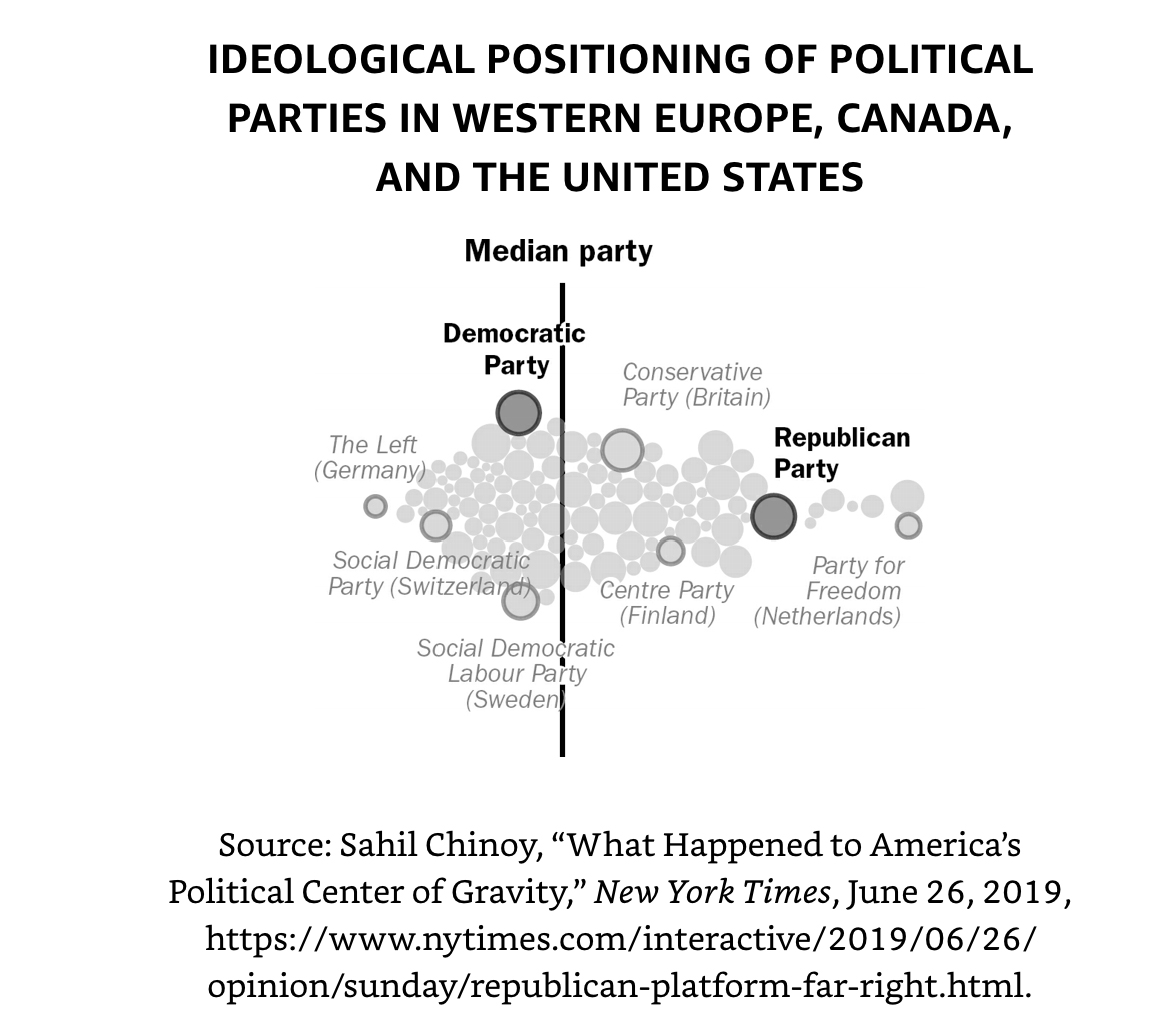 A Donald Trump supporter recently smiled at me and said approvingly, “Trump is a radical.” Trump wants rapid change. He is upsetting lots of applecarts, and he is doing so in as showy a manner as possible. That is not conservative.
The Authoritarian Dynamic
Stenner and Haidt, in “Authoritarianism Is Not a Momentary Madness, but an Eternal Dynamic Within Liberal Democracies,” explain the current rise of right-wing movements worldwide by placing what is happening in the context of what Stenner calls the Authoritarian Dynamic. The Authoritarian Dynamic works like this:
- Democracy naturally expands and becomes more diverse as out-groups are admitted.
- As democracy expands and becomes more diverse, those with authoritarian dispositions become susceptible to a leader who arouses their fears.
When the fears of those with authoritarian personalities are aroused, they can become cruel or justify cruelty.
When the fears of those with authoritarian tendencies are not aroused, their authoritarian tendencies will lie dormant. However, when riled by a normative threat—which is something that threatens sameness and order—they can show aggression toward out-groups. They can become cruel and tolerate cruelty in others. Driven by fear, they may be willing to trample rules.
To use the ancient Greek term, the leaders who trigger the fears of authoritarians are demagogues.
As the world becomes more complex and diverse, people with authoritarian personalities recoil. Stenner attributes the current rise of far-right-wing extremist movements worldwide to the simple fact that the complexity of today’s world has exceeded many people’s capacity to tolerate it. Those who cannot tolerate the cacophony and complexity of today’s world become susceptible to leaders who arouse their fears and unleash their authoritarian tendencies.
Can Biology Explain Our Political Differences?
A study published in Current Biology in April 2011, “Political Orientations Are Correlated with Brain Structure in Young Adults,” found that people who identify as liberals and people who identify as conservatives show measurable differences in their brains.
MRI scans revealed that self-described conservative students had a larger amygdala than those who identified as liberals. The amygdala is an almond-shaped structure in our brains that becomes active during states of anxiety. The researchers concluded that self-described conservatives are more sensitive to perceived threats, more fearful, and therefore more cautious.
In contrast, students who described themselves as liberal had more gray matter in the anterior cingulate cortex, a region of the brain that helps people cope with complexity.
It makes sense to me that the person who is more cautious and sensitive to threats would prefer the status quo.
The researchers stressed that biology is not destiny. They concluded that a person’s political views reflect a combination of genetic influences and environmental factors. Their data, however, suggest a link between brain structure and the psychological mechanisms that lead people to their political inclinations.
It also makes sense to me that the brain can change due to external factors. If you lift weights, the muscles in your arms will change. How much muscle you can build is limited by genetics. Psychologists refer to “thought loops”—repetitive thought patterns that can lead toward cognitive rigidity. As I understand a thought loop, it is like exercising a muscle. Do it often enough and your brain will change in measurable ways.
When I moved from San Francisco to California’s central coast in 2017, I hired a contractor to replace a rotted back door to the garage. Once he understood that I had moved from San Francisco, he pegged me as a liberal and tried to goad me into an argument.
It didn’t work. He told me that he has guns and likes to sit on his front porch and shoot animals. I offered no response. He mocked Hillary Clinton. I smiled.
I pointed to the door that needed to be replaced—a glass, French-style door—and told him that I wanted another just like it. He said that would be a terrible idea. I asked why. He explained that it would be too easy for someone to break into a glass door. A door to the garage, he said, should be more secure.
I wasn’t worried. I said, “I don’t have anything in this garage worth stealing.”
His response: “A burglar won’t know that and will break the glass anyway to search.”
I shrugged and said, “Then I’ll just leave the door unlocked. That way the burglar won’t need to break it.”
He stared at me. I assume he was trying to figure out whether I was joking. What I was doing was goading him back. I also wanted a door with windows, and his fears seemed silly to me. Glass doors are a thing. Lots of people have doors with windows.
He was a large man who literally towered over me. I stood firm at my height of 60 inches. “I want a glass door,” I said. In fact, I had already selected the one I intended to buy.
I had recently read the article in Current Biology and wondered if there was a connection between his fear of burglars and his political views. I also wondered if his need for guns was a result of his fears. At the same time, as a friend later pointed out, I was probably living up to his stereotype of a liberal who was foolish enough to leave doors—and maybe even the borders—unlocked.
As Haidt suggests, maybe a liberal needs someone to remind her to lock the doors because dangers do exist.
Ideological Thinking
Leor Zmigrod, the author of The Ideological Brain: The Radical Science of Flexible Thinking, is a political neuroscientist with an impressive resume. When she heard about young British girls drawn to Syria to join ISIS, a question tugged at her: Why were these particular girls lured into extremism? Her book is the result of research into how people spiral into extremism. Among her conclusions is that, given variations in brain structure, some people are more susceptible to the lure of extremism than others.
Her research confirms that biology isn’t destiny. She explains how our brains can, through outside influences, become more prone to ideological thinking. She tells us that different people are born with different inclinations toward rigid thinking. Factors such as early indoctrination, fear of death, and panic can make a person more susceptible to ideological thinking. A person’s thinking can change over time, becoming more or less flexible depending on environmental factors.
Zmigrod describes ideological thinking as “the style of thinking characterized by rigid adherence to a dogma and a rigid social identity.” An ideology, she tells us, is a kind of narrative that tells a compelling story about the world. Not all stories, theories, or ideas are ideologies. An ideology offers an absolutist description of the world and prescribes how we should think, act, and interact with others. Within an ideology, nonconformity is intolerable. Deviation from the rules can lead to severe punishment or ostracism. An ideology demands rigid and ritualistic thinking. People in the grip of an ideology are less curious and less free.
All ideologies, Zmigrod tells us, share particular traits. For example, all ideologies seek a utopia. Stalinists and Leninists looked forward to an ideal world of economic equality. Nazis looked backward to a time when there was perfect order and when they believed the “superior” race ruled.
Any idea or theory can become an ideology if it morphs into a rigid set of rules that grips the brain and essentially turns a person into a fanatic. Zmigrod offers the example of Karl Marx, who advocated freedom from oppression. He hated ideologies, which he believed were used by the ruling class to keep the working class in line. He famously said that religion is the opium of the masses. Then, in the hands of Vladimir Lenin and Joseph Stalin, Marx’s philosophy became an ideology used to oppress others.
Zmigrod tells us that when a person is in the grip of an ideology, reverberations of that ideology can be measured in the brain, even when the person is not thinking about politics. In other words, the person’s brain actually changes.
Her research showed that those better able to resist ideological thinking have more flexible brains. She measured brain flexibility by observing, through experiments, who was able to switch from one set of rules to another. When the game changes, those with more flexible thinking were able to adapt.
People with inflexible brains tend to be intellectually arrogant. They rarely admit they are wrong. For that matter, they rarely think they are wrong. They don’t say, “On the other hand,” and see other viewpoints.
People with flexible brains, in contrast, are intellectually humble. They can entertain the possibility that they may be wrong, and they can recognize when they are wrong. Such people are, by nature, freer. In the words of Judge Learned Hand:
Bertrand Russell illustrated intellectual humility when he quipped, “I would never die for my beliefs because I might be wrong.”
Being in the grip of an ideology is satisfying. A complicated world suddenly becomes simple and digestible. Everything makes sense. There are bad guys (our enemies) who are seeking to destroy everything we hold dear. There are good guys (our allies) with whom we stand shoulder-to-shoulder in solidarity.
This is the world:
 This is the world with your brain on ideology:

Government, when viewed through an ideological lens, becomes simplified. Forget those complicated civics lessons from your high school government class. If we can just gain control of the government and set things right, we will all live happily ever after in (pick one):
- A perfectly egalitarian democracy.
- A well-ordered society in which all people have personal freedom.
- Some other perfect world.
Here is how Zmigrod describes what happens as a person is drawn into ideological thinking:
In a given community, everyone will be positioned at different starting points, but the environment they choose (or are forced into) will affect how rapidly the person will adopt the most extreme conclusions of an ideology . . .Once sucked into ideological logic and community, it becomes easier and easier to get drawn more deeply inward—and more difficult to come out.
As the person spirals into ideological thinking, the brain is altered and becomes more accustomed to the ideological thinking. As the brain becomes accustomed to ideological thinking, the spiral becomes tighter and harder to escape. “The spiral,” Zmigrod says, “reflects the interaction between a person’s dispositions and their ideological environment.”
Zmigrod’s research led her to conclude that the most flexible thinkers are those just to the left of center on the political spectrum. The least flexible thinkers exist at the extreme points of the political spectrum.
What is striking are the similarities among Zmigrod’s descriptions of ideological thinkers, Stenner’s description of those with authoritarian personalities, and the study in Current Biology showing brain differences associated with different political leanings. Stenner and Zmigrod both describe rigid thinkers as people who insist on conformity, people who prefer absolutes, and people who are less open-minded. The study in Current Biology confirms that political differences are measurable in the brain.
When different researchers in different fields using different methods of inquiry come to the same conclusions, there is less chance that the conclusions are the result of bias or a flaw in their research methods. In other words, we can conclude that there is something going on with this whole brain-structure-and-politics thing.
Ideologies Soothe Existence Pain
Existence pain, as you might expect, is the pain that comes from merely existing as a human. Existence pain includes our awareness of our mortality. It involves confronting what can feel like the meaninglessness of life. It means fearing the loss of those we love. If we don’t have loved ones, it means facing solitude. It means fearing the isolation that often accompanies old age. Existence pain includes grappling with the indifference of the universe. It means knowing that what lies ahead—should we live long enough—is physical pain as our bodies break down. It means facing the possibility that there may not be a grand eternal plan.
In the words of psychiatrist Irvin D. Yalom, existence pain is the “pain that is always there, whirring continuously just beneath the membrane of life.” It is knowing that “our deepest wants can never be fulfilled … a halt to aging, the return of vanished ones, eternal love, significance, immortality itself.”
The First Noble Truth in Buddhist philosophy emphasizes that life is full of suffering. “Existence pain” is another way of saying the same thing.
Ideologies offer relief from existence pain. An ideology may offer the promise of an afterlife. It may give life a purpose. It may offer the promise of a grand eternal plan. It may offer camaraderie. It soothes the pain of existence and gives meaning to our suffering.
To echo the ideas of Friedrich Nietzsche, people spend their lives searching for the purpose of life as though it must be something beyond itself. But the purpose of a lion’s life is to be a lion. This suggests that the purpose of a human’s life is simply to be a human. As I understand that, the purpose of our lives is to strive to become more fully human. That requires us to develop our most unique capacities: the rational and socially oriented thinking enabled by our advanced brain regions.
If, as Aristotle famously said, “man is a rational animal,” the purpose of our lives should be to become more rational.
And how do we do that?
One way is to turn to the artists. Almost all the arts use metaphor or symbol to some degree. Robert Sapolsky, a neuroscientist and primatologist at Stanford University, tells us that among the qualities that are uniquely human is the ability to think in metaphor and symbols. So, when we practice using metaphors, we are using a part of the brain that is uniquely human.
The visual artist teaches us to see both beauty and pain. In an essay called “The Decay of Lying,” Oscar Wilde rejects the widely held idea that art imitates life. Instead, he suggests that life imitates art. He goes even further and argues that nature itself takes its cues from art.
You might say that the nineteenth-century landscape painter Joseph Mallord William Turner taught us to see the beauty in sunsets.
 The Fighting Temeraire Tugged to Her Last Berth to Be Broken Up
by Joseph Mallord William Turner (1838)
Wilde says no. He says that the beauty in landscapes exists because the artist taught us how to see it. Nature, he says, literally follows the landscape painter and takes her effects from the artist.
Wilde explained it like this:
Where, if not from the Impressionists, do we get those wonderful brown fogs that come creeping down our streets, blurring the gas lamps and changing the houses into monstrous shadows? To whom, if not their master, do we owe the lovely silver mists that brood over our river . . .
For what is Nature? Nature is no great mother who has borne us. She is our creation. It is in our brain that she quickens to life. Things are because we see them, and what we see, and how we see it, depends on the Arts that have influenced us . . .
At present, people see fogs, not because there are fogs,
but because poets and painters have taught them the mysterious loveliness of such effects. There may have been fogs for centuries in London. I dare say there were. But no one saw them, and so we do not know anything about them. They did not exist till Art had invented them.
Yesterday evening Mrs. Arundel insisted on my going to the window, and looking at the glorious sky, as she called it. Of course I had to look at it. And what was it? It was simply a very second-rate Turner, a Turner of a bad period, with all the painter’s worst faults exaggerated and over-emphasized.
Of course, fogs and sunsets exist without a viewer, but what we see as beautiful is shaped by experience, learning, and cultural expectations. Wilde’s argument is that, because what we consider to be nature and what we consider to be beautiful are our own constructions, and because the artist teaches us to see beauty, nature does indeed take her effects from the artist.
In the 1980s, I attended a lecture at the Massachusetts Institute of Technology. The lecturer, a historian, marveled at the fact that a group of medieval monks traveling through the Alps never once commented on—or even seemed to see—the glorious beauty of the landscape. Well, of course they didn’t see it. That was before the Romantic era landscape painters taught people to see the beauty in a wild and rugged landscape. Very likely, the monks saw only a dangerous, difficult-to-travel wilderness in which they might at any moment be attacked by animals. They were not wrong. It was a dangerous wilderness. Nobody had taught them to also see the beauty.
Samuel Coleridge famously said, “I have a smack of Hamlet myself.” It’s possible that many of us have a little Hamlet in us, which means Shakespeare taught us to see something in ourselves.
If we imitate literary figures and then, through the imitation, absorb some of those characteristics, isn’t life imitating art? The little girl obsessed with Disney princesses who wears her princess outfit and practices being special learns the lesson Sara Crewe learned in Frances Hodgson Burnett’s The Little Princess: “I am a princess. All girls are!”
Life Imitates Art
A classical tragedy can show how well-meaning human beings, through their actions or inactions, can create unnecessary pain and suffering. In other words, a classical tragedy can explore how people become cruel.
Antigone by the ancient Greek playwright Sophocles does exactly that. Here is the plot in a nutshell. Creon, the king, makes a law that Antigone, a citizen, knows is unjust. Antigone disobeys the law because she would rather be a good person than a good citizen. Creon is determined to punish her because he insists that all order and civilization will break down if citizens don’t obey the law. In his zeal to punish Antigone, Creon becomes vengeful and cruel. In the end, he destroys himself and those he loves.
The German philosopher Georg Wilhelm Friedrich Hegel, in his Lectures on Aesthetics, said that Antigone was “one of the most sublime and in every respect the most excellent work of art of all time.” He believed the play was about opposing moral claims: Creon claims that justice requires punishing all people who break the law. Antigone claims that justice means doing what is right.
Antigone teaches us that important questions about power, government, law, and punishment defy easy answers. After absorbing Antigone, we can see what is wrong with the law-and-order people who shake their fists and shout, “All lawbreakers must be punished, or the rule of law will be destroyed!”
The artist helps us confront and process the complexity of life.
Art can also show us we are not alone in our emotions. Among the most iconic of all paintings, The Scream (1893) by Edvard Munch, captures nothing less than the cacophony, uncertainty, and anxiety of the modern age.
While wandering through an art gallery, I was struck by the work of French painter Stéphanie Ledroit. With her permission, I am including some of her artwork here.
We are essentially social creatures, so we naturally fear isolation. The phrase “In the end we are all alone,” which has been attributed to various sources, therefore resonates.
Ledroit shows us that solitude can be a time of renewal, a time to look inward, a time of creativity, or a time to discover new things about ourselves. She uncovers the beauty that can be found in isolation. I asked her why she often paints children, and she said, “Because they naturally slip into their own space.”
The Artist and the Demagogue
The demagogue riles us to hate and fear and makes us more brutal, more simplistic, less human, and less humane. Conversely, the true artist teaches us to embrace complexity and become more fully human.
Before law school when I taught college English, I always ended my lessons on metaphors and similes by writing on the board, “Metaphors Be with You.” At the time, I thought I was offering a joke. In fact, I was offering sage advice for how to cultivate a habit of mind that grows accustomed to complexity and can withstand easy answers. I was also offering advice for how to become more fully human.
The more we practice embracing complexity—and the more we work on expanding our sympathies, however we choose to do it, like a gymnast stretching her muscles—the more flexible our thinking can become, and the better we are able to withstand ideological thinking.
That, I believe, is what Fyodor Dostoevsky meant when he said, “The world will be saved by beauty.”