
Chapter 5
Social Media Makes it Worse
The Internet, the second major information revolution after the printing press, did more than simply facilitate the spread of misinformation and disinformation. It transformed how people communicate. It also revolutionized how news is transmitted.
Because the cost of producing and distributing information is falling close to zero, people are deluged with choices of what to pay attention to. A person with a Substack account that costs $5 per month per subscription can earn $10,000 per month with only 2,000 subscribers. The only requirement is to write content that appeals to—and hooks—a few thousand people. Where once CBS, NBC, ABC, and major newspapers aimed for neutrality to reach as large an audience as possible, audiences are now broken down into numbers as small as a few thousand. These smaller outlets, therefore, have an incentive to affirm the biases of their audiences.
According to the Pew Research Center, in 2024, nearly a third of all consumers of news got their news “often” from social media. An additional 24 percent get their news “sometimes” from social media. That encourages tailoring news and commentary to fit narrow tastes and specific demands.
Social media as a source of news has created a phenomenon known as ideological filter bubbles built through algorithms. An Internet algorithm draws on vast amounts of user data to predict and deliver the content each person is most likely to find engaging. The term “filter bubble” was first coined by Eli Pariser in his 2011 book, The Filter Bubble: What the Internet Is Hiding from You. He showed that when a person searches for information online, algorithms show users personalized content based on their online behavior, such as search history, location, and past clicks. That means users are shown information that aligns with their existing beliefs and interests, thereby reinforcing those views. This is getting worse as artificial intelligence gets better at telling people what they want to hear and confirming their biases.
The Pew Research Center has found that nearly all the content people see on social media is chosen, not by human editors, but rather by algorithms. On a social media platform, the algorithm will suggest other people to follow based on who the user already follows and the kind of content the user engages with. That is how people end up in ideological filter bubbles, which are highly efficient conspiracy-theory, rage-generating machines. They work like this:
- Person A sees a misleading headline or a headline stating an opinion as if it is a fact.
- Person A clicks on it, skims the article without reading closely, thereby missing the subtlety. The person clicks “like.”
- The algorithm shows Person A lots of like-minded partisans talking about the opinion in the article as if it is a fact.
- The algorithm then shows the person a “legal expert” commenting approvingly on the misleading headline. The algorithm is smart enough to show a “legal expert” who shares Person A’s political views. (I have learned that every lawyer becomes a legal expert on social media. In real life, there are good lawyers, mediocre lawyers, and bad lawyers. On social media and cable news, all are legal experts.)
- Over the coming days, weeks, months, or even longer, members of Person A’s community continually reinforce her beliefs.
Person A is simply a misinformed person. Multiply Person A by hundreds of thousands or even millions of people in an ideological filter bubble, and you have a situation.
In a 60 Minutes interview, Facebook whistleblower Frances Haugen explained that “angry content” on Facebook is more likely to receive engagement. She said that content producers and political parties are aware of this. In her testimony before Congress, she said that Facebook algorithms deliberately incentivize angry, polarizing content. Social media users who want to amass a large following in political filter bubbles learn quickly that content that either confirms the biases of their audiences or generates anger will bring them more engagement.
Social media algorithms create conflict by elevating material that promotes division and creates rage. Platformer learned that X (formerly Twitter) under Elon Musk’s leadership, maintained a list of around thirty-five VIP users whose accounts it monitors and offers increased visibility. The list includes the following:
- Daily Wire founder and conservative commentator Ben Shapiro
- Pseudonymous conservative commentator @catturd2
- Rep. Alexandria Ocasio-Cortez (D-NY)
As observers have noted, figures like Ben Shapiro and @Catturd2 enrage the left. Alexandria Ocasio-Cortez enrages the right. Elevating these users stimulates engagement by riling people. Getting people fighting is profitable for X’s revenue stream.
There is a thing on X called dunking. The dunkee says something outrageous or painfully stupid. The dunker reposts the statement and dunks on it by adding a clever or snarky statement intended to highlight the outrageousness or stupidity of the statement. This works best if the dunkee is a public figure.
Both sides think they win a dunking contest. The dunker shows how clever he or she is, and the dunkee gets to be the star of a show entitled Watch Me Trigger the Enemy. The dunking game drives up partisanship and increases engagement.
The left-wing media ecosystem and the right-wing ecosystem have been erroneously called echo chambers. An echo chamber implies that people in each ecosystem are only exposed to views from their own side. In fact, audiences in each ecosystem are continually shown the views of the other side. After all, that’s what dunking is all about.
Leor Zmigrod compares online political communities to life in a “tightly controlled propagandist state.” She says this:
Take a vulnerable mind—sensitive to negative information and threats, cognitively rigid, impulsive—and place this mind in an environment that selectively preys on these biases, and it becomes possible to understand why these spaces, though toxic for everyone, are especially toxic for people who are at baseline already psychologically vulnerable. The more technology obfuscates the source, truth, and reliability of images, texts, videos, and reports, the more likely it is that digital environments will be radicalizing spaces.
The current incendiary media environment, which activates the authoritarian instincts of people while vilifying people on the other “side,” does something more sinister than simply exacerbate the polarization. Recall the words of Judge Learned Hand:
The spirit of liberty is the spirit which is not too sure that it is right; the spirit of liberty is the spirit which seeks to understand the minds of other men and women.
People whose fears and rage are continually activated in this manner become less free and less humane. They are being carefully taught to hate and fear.
The Other Divide
In The Other Divide: Polarization and Disengagement in American Politics (2022), authors Yanna Krupnikov, professor of political science and communication, and John Barry Ryan, political scientist, argue that the main division in US politics isn’t between the left and the right. It’s between a relatively small group of vocal hyper-partisans and the larger group who have elected to tune out the noise.
Krupnikov and Ryan divide Americans into three groups. The first group is uninvolved in politics. They pay no attention, and they generally don’t vote. The second group focuses on politics when something is important to them, and they vote. The third group—the vocal hyper-partisans—dominate the landscape. They also genuinely dislike rank-and-file members of the opposing party. Some members of the third group even wish ill on out-partisans. In contrast, people in the first and second groups may dislike the policies of some opposing party leaders, but they bear no ill will against people who vote for the opposing party.
Because these vocal, deeply involved hyper-partisans attract disproportionate attention, this group wields an outsized influence on how Americans perceive politics.
Krupnikov and Ryan dispel the popular notion that the outrage industry is a result of polarization. They argue instead that the outrage industry arose because it was profitable, but it has exacerbated the problem of polarization.
All of this is damaging what sociologists call the public sphere, a place where citizens come together to exchange ideas regarding public affairs and eventually form public opinion. It can be a specific place where citizens gather (such as a town hall meeting) or a communication infrastructure where citizens send and receive information and opinions.
The problem, of course, is that a functioning public sphere is necessary for a democratic government to function as it should.
My Social Media Adventure
In 2018, when my social media adventure began, I knew nothing about algorithms, the outrage industry, the dangers of partisan punditry, or ideological filter bubbles. I’d soon get a crash course.
One of my earliest lessons was how easily we can be deceived online. Two anonymous accounts claiming to be lawyers had me believing for a while that they were, in fact, lawyers. They posted about legal matters and offered legal opinions. When I realized they were not lawyers, I confronted each of them privately. One soon deleted his account because he had overreached, made absurd predictions, and imploded. The other is still online pretending to be a lawyer. Faking being a lawyer takes work because he has to read legal stuff and then comment on it. I figure he has been faking it so long now that he probably knows as much as some real lawyers.
I also saw firsthand how the sheer complexity of our legal system can give rise to conspiracy theories. My first “viral” thread on Twitter (back when it was called Twitter) happened in September 2018 when a few Twitter users who were in a panic asked me about a case going to the United States Supreme Court, Gamble v. US, which they insisted would expand Trump’s pardon powers and therefore undo the special counsel probe into the Russian election interference in the 2016 election.
As President, Trump already had the power to issue pardons for federal crimes, so I did some digging. I found the briefing for the case and read it. It seemed to me that the case had nothing whatsoever to do with the presidential pardon power or the special counsel investigation. The case was about a man in Alabama named Terance Martez Gamble who was convicted of possession of a firearm and sentenced to an Alabama prison. After he was convicted in state court, federal prosecutors sought to charge him with the same crime.
Gamble appealed, arguing that being tried and convicted for the same crime violated the Double Jeopardy Clause of the U.S. Constitution, which states, “. . .nor shall any person be subject for the same offence to be twice put in jeopardy of life or limb . . .”
Unfortunately for Gamble, in 1959, the Supreme Court had affirmed something called the Dual Sovereignty Doctrine. This doctrine holds that because state and federal governments are separate jurisdictions, a person who violates both state and federal laws can be charged in both. Gamble was challenging constitutionality of the Dual Sovereignty Doctrine and asking the Supreme Court to overturn it.
I could not understand how people leaped from Terance Martez Gamble challenging a double conviction in Alabama to Trump escaping justice in the special counsel probe.
I traced the confusion to an article in The Atlantic.
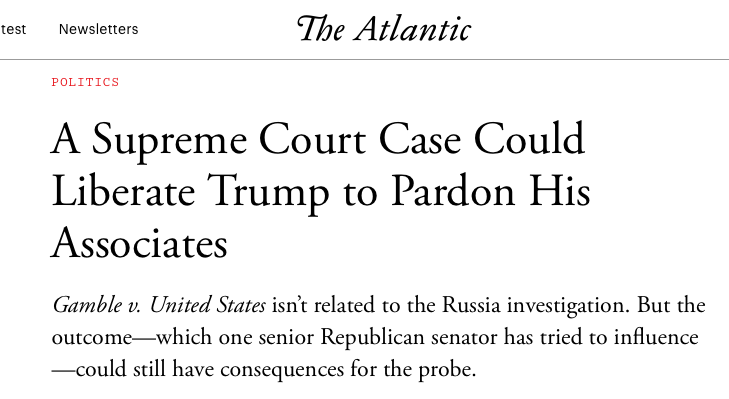
The Atlantic advertises itself as fact-driven and aiming for thoughtful engagement. So, let’s look at what happened.
The article included a large, unflattering picture of Trump. That alone might make people think the case was about Trump. However, the language in the lead, “could still have consequences” and “isn’t related to the Russia investigation,” should have been a clue that the connection was remote and the article contained speculation.
The theory connecting the case to the pardon power was this: If the Dual Sovereignty Doctrine was abolished, and if Trump or his associates were found to have committed a crime in connection with Russia’s attack on the 2016 election, and if the crimes could be charged in both federal and state court, and if the feds went first, Trump or his associates could only be charged in federal court, and not both federal and state courts. That would “expand” Trump’s pardon power because he could then pardon himself or his associates in the only jurisdiction where he could be charged.
That is what I would call a creative legal theory.
The “evidence” presented for why the case “could liberate Trump to pardon his associates” was that Republican Senator Orrin Hatch urged the Supreme Court, in an amicus brief, to overturn the Dual Sovereignty Doctrine. The theory was that if a conservative Senator tried to influence the outcome, it must be good for Trump; therefore, it wasn’t really about Gamble serving two sentences. It was about Trump escaping justice.
One problem with that theory is that Hatch was a longtime advocate of criminal justice reform. The argument Hatch made in his amicus brief was that the Dual Sovereignty Doctrine should be overturned because it infringed on liberty and violated the Double Jeopardy Clause. Hatch made a decent argument. Is it really fair for someone to serve two sentences for the same crime? If each sentence, separately, was deemed by the respective legislatures to be appropriate for the crime, surely essentially doubling the punishment would be unjust.
I dug deeper and learned that when Trump critics who were following the special counsel investigation found out about the pardon power, they fretted that Trump might be able to pardon himself for any crimes. Lawyers told them not to worry because, if Trump was found to have committed crimes, he likely also committed state crimes, so he could also be charged with those, for which he could not pardon himself.
So, I could see how the reporter got the idea that the case was about the pardon power. I attributed the error to the sheer complexity of the American legal system.
As a result of the framing that Gamble v. United States was about the pardon power, the case got a lot of attention. Other outlets picked up the framing of the story.


At the same time this was happening, Brett Kavanaugh was in the process of being confirmed to the Supreme Court. A celebrity who often spoke out against Trump spread the theory that the Republicans were in a hurry to confirm Kavanaugh so he could help Gamble win, which would allow Trump and pals to escape justice. The celebrity posted this to her three million followers on Twitter.
She deleted the post later when she understood she was wrong. I took a screenshot before she deleted it. I also removed her name.
I won’t stop to point out the problems with the facts and logic in her post. I’ll just note that others who picked up the idea that there was a nefarious plot to give Trump’s associates a get-out-of-jail-free-card said things like this: “The system is unfair! Rich powerful guys get off the hook while poor people get sent to prison for lesser crimes!” The irony is that these same critics were hoping that Mr. Gamble, a guy in Alabama who was decidedly not a privileged billionaire, would have to serve two sentences on the outside chance that this would hurt Trump or his associates.
I responded to the panic by writing a Twitter thread explaining why Gamble v. United States wasn’t about the pardon power and why, even if there were crimes to charge Trump and his associates with, it was unlikely to impact the special counsel’s investigation.
My thread, of course, did nothing to allay the panic, so I tried something bigger. I coauthored a piece for Slate with Fordham law professor Jed Shugerman explaining the same thing. As you would expect, our article also did nothing to allay the panic. You cannot put out a forest fire with a squirt gun.
As it turned out, Gamble lost and would have to face prosecution for the same crime in federal court. Kavanaugh, along with five other Justices, voted to uphold the Dual Sovereignty Doctrine. In other words, Justice Kavanaugh didn’t vote the way (according to the current theory) that would help Trump. That’s because the case wasn’t about Trump. It was about Gamble and the Dual Sovereignty Doctrine. Justices Ruth Bader Ginsburg and Neil Gorsuch dissented. They agreed with Orrin Hatch that the Dual Sovereignty Doctrine was fundamentally unfair and undermined the Double Jeopardy Clause. So you see, people don’t always fit into the expected boxes.
The idea that Republicans were secretly working in the shadows to expand Trump’s pardon power so he could pardon himself and escape justice in the special counsel investigation meets the requirements for a conspiracy theory as described by Professor Young.
Left-Wing and Right-Wing Conspiracy Theories
Now I’ll show you other examples of left-wing and right-wing rage-media-generated conspiracy theories. Remember, a conspiracy theory doesn’t need to be unhinged or absurd. It simply needs to falsely assign blame for a confusing situation, and the blame must be assigned to powerful people working in the shadows.
I’ll randomly take all examples from the same week in March 2024.
On March 25, 2024, we learned that a New York appellate court, in a case called New York v. Trump, reduced Trump’s bond from $454 million to $175 million.
The lower court had found Trump liable for inflating his net worth on financial statements over the course of a decade to secure better loans and insurance deals. Trump appealed. To postpone paying the penalty while the case was on appeal, he was required to post a bond. Trump told the court that securing the cash to cover a $454 million bond was a “practical impossibility” and he could not do it. His lawyers argued that “a bond of this size is rarely if ever seen. In the unusual circumstance that a bond of this size is issued, it is provided to the largest public companies in the world, not to individuals or privately held businesses.”
The court lowered the bond amount and gave Trump ten days to secure the bond.
A bond is not intended to be a punishment. It is intended to prevent the winning party from executing the judgment while the appeal is pending. Several well-known pundits confirmed for cable audiences that what the court did when it reduced his bond amount was not uncommon. Here is what factual news reporting would look like:
Donald Trump claimed that securing the cash to cover the bond amount was a “practical impossibility” and unusually large for a case like this one. The appeals court reduced the amount Trump must pay as bond from $450 million to $175 million—and gave him an additional ten days to post it.
Here is how MSNBC legal expert Tristan Snell responded:
He then said that anyone except Trump who claimed not to have the cash would be told, “Sorry, buddy, you lost. Pay up.”
It seems to me that if that were true, if a person who couldn’t afford the bond could not appeal, it would mean that only wealthy people would be permitted to appeal large judgments.
What Snell offered was an angry tirade implying that the court, behind the scenes, was behaving unethically. In real life, of course, lawyers are always having rants about what courts do. But this isn’t news. It’s a personal rant. The problem is that people listening to Snell on MSNBC may take what he says as truth instead of an angry rant that the judge didn’t do what Snell wanted the judge to do.
If the measure of success is riling the audience, I give him a high grade. Just listening to his tirade, which I’d certainly characterize as an emotionally evocative performance, made me feel tense and angry. His audience would certainly feel a righteous anger.
Snell posted this on X:
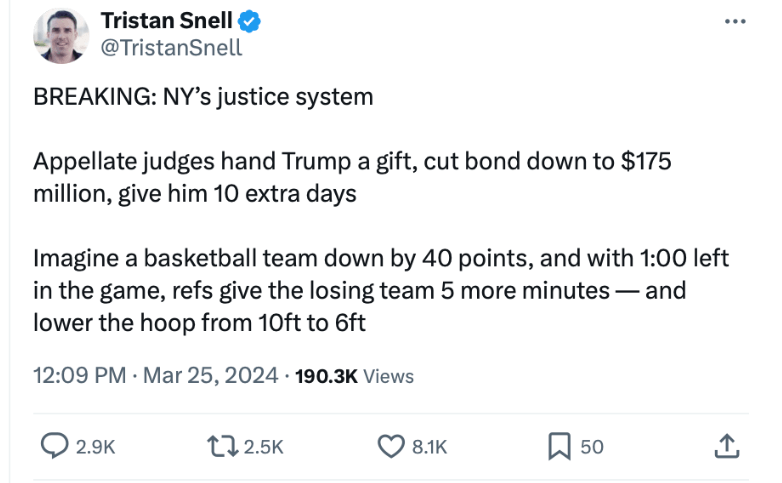
Notice the attempt at humor. What is “breaking” is the New York justice system. The implication is that the courts are cheating on Trump’s behalf.
The response meets the criteria for a conspiracy theory as described by Dannagal Goldthwaite Young. Something happened that appears “inexplicable.” Trump’s bond was lowered! People look for a way to assign blame. The courts are corrupt! The audience feels part of a group of like-minded outraged citizens. I glanced at a few of the comments on Snell’s post, and people were absolutely outraged by this horrible, terrible miscarriage of justice.
It seems to me that, among other things, there is a potential problem here with burnout. If there is an earth-shattering crisis every day, won’t some people get numb to it?
The counterintuitive part is that some people will become addicted to the rage. Neuroscientists tell us that this kind of rage feels good because it confirms the biases of the audience and allows them to get behind a banner. They feel in control. They will tune in tomorrow for more, which drives up ratings. We can call it, “enraging people for fun and profit.”
Here is another example from the same day in March of 2024. The story began a few weeks earlier in a different case, The People of the State of New York v. Donald J. Trump, more commonly known as the hush money case. What happened was this: Trump’s legal team claimed that the prosecution dumped tens of thousands of documents on them at the last minute as part of a “strategy to hide the truth.” Trump’s legal team therefore asked for an extension for an upcoming deadline. On March 14, 2024, the court agreed to a thirty-day extension of time to assess Trump’s claim.
Factual reporting would look like this:
Trump claimed that, because of a last-minute document dump, he could not meet his deadline. In response, the court agreed to a thirty-day extension to assess Trump’s claims.
If a network has hours of time to fill, that would obviously not be enough.
Before I show you the spin, hype, and a conspiracy theory, I’ll tell you how the story ends. On March 25, after the court had a chance to assess the alleged discovery document dump, Judge Merchan found that Trump and his lawyers misrepresented the facts and that there were no errors on the part of the prosecutors.
The judge, who was visibly angry at Trump’s team, said: “It’s incredibly serious, unbelievably serious. You are literally accusing the Manhattan District Attorney’s office and the people involved in this case of prosecutorial misconduct and trying to make me complicit in it.”
On March 14, when Trump was given his extension, before anyone had any facts, Andrew Weissman, a lawyer, appeared on an MSNBC show.

The MSNBC banner announced “The Justice Delay.” The headline offers an emotional quotation from Weissman, “You’ve got to be kidding!”
The host opened by presenting Trump’s claims of a document dump as if it were true, even though she didn’t know. She then implied that the prosecutors screwed up. She asked legal expert Andrew Weissman, “What is going on?” He spoke firmly and decisively when he responded with, “At the very least, this is a massive screw-up on the part of the Southern District of New York prosecutors.” He accused the SDNY prosecutors of “poor judgment.”
Melissa Murray, who is also a lawyer, appeared on the show. She blamed U.S. Attorney General Merrick Garland for the screw-up, even though we find out later that there was never a screw-up.
This, too, is a conspiracy theory. These two legal experts leaped to the conclusion that the prosecutors had screwed up. They falsely assigned blame for something that seemed inexplicable, a last-minute document dump.
When the facts came out, I checked the social media feeds of both Melissa Murray and Andrew Weissman to see if they apologized for their errors. I found no apology or admission of error. They were on to the next outrage. In this new world of outrage media, nobody admits error. There is no collective memory in an ideological filter bubble. Members of the audience come and go. The people who remain are already on to the next outrage.
I have observed that when social media political influencers are wrong about something, they respond by changing the subject and posting content that affirms the biases of their audiences. That keeps them from losing credibility.
I have also observed that, when confronted with contradictory facts, people in ideological filter bubbles find ways to dismiss the evidence, like this: “Okay, maybe the prosecutors didn’t screw up this time, but they’re always screwing up, which is why Trump gets away with everything, so it wasn’t really a lie.”
Keith M. Bellizzi, a professor of human development, explains why, when it comes to politics, new facts often do not change people’s minds. A challenge to a person’s worldview may feel like an attack, which can cause that person’s views to harden. Cognitive bias kicks in when people encounter evidence that contradicts their firmly held views. Instead of reevaluating their beliefs, they reject the new evidence.
Now, here is an example of a right-wing conspiracy theory.
On March 26, 2024, at 1:28 a.m., the Francis Scott Key Bridge across the Patapsco River in Maryland collapsed. Six members of a maintenance crew who were working on the roadway were killed. Two more were rescued from the river.
When the bridge collapsed, the public had no information. A preliminary report from the National Transportation Safety Board several weeks after the accident indicated that a container ship lost power and drifted into a support pier, triggering a catastrophic chain reaction that led to the collapse.
Immediately after the bridge collapsed, before the public had any information, Anthony Sabatini, a Republican who served in the Florida House of Representatives, posted a response on social media.

DEI stands for diversity, equity, and inclusion. The implication, of course, is that the bridge collapsed because unqualified people were hired because of their race.
Fox News personality Maria Bartiromo mused that the “wide-open border” was responsible for the bridge collapse. She blamed President Joe Biden’s immigration policies.
Matt Schlapp on Newsmax said the bridge collapsed because of “drug-addled” employees and COVID lockdowns.
Sabatini’s “DEI” post is still online. I assume that it doesn’t seem like a lie to people who reason that “it could be the result of DEI” or “it is likely the result of DEI” or “even if DEI didn’t cause this, we know it causes lots of damage.” In other words, the lie can be explained away as pointing to what people might think of as a larger truth.
From these examples, you might conclude that the right wing does it better. The right-wing conspiracy theory is more simply stated and more graphically presented. It is also clear what the right-wing pundits hoped to gain. They dislike immigration, DEI as a policy, and COVID lockdowns. Blaming the things you dislike for anything that goes wrong achieves the goal of making other people hate the things you dislike. That, in turn, furthers the goals of a platform that wants to curtail immigration and end DEI hiring.
The left-wing conspiracy theories are more subtle and less graphic. Second-guessing a court’s decision and suggesting that the courts are corrupt, that Trump gets preferential treatment, or that the prosecutors screwed up is much less direct. It is also unclear to me what the left-wing gains by attacking the legal system as corrupt. Do they really want Americans to hate the legal system? Does turning people against the legal system benefit liberal policies?
My conclusion is that MSNBC pundits needed a compelling story, and anything related to Trump interests viewers. Accusing the prosecutors who indicted him of screwing up engages and riles the audience.
I am not suggesting that the left wing needs to get better at this. I am suggesting that consumers of news need to see through what is happening. The partisan pundit model is making people less informed and angrier, which risks pushing people into ideological thinking and extremism.
It’s easy to see where this is leading. Rage merchants are pushing two groups of angry hyper-partisans to the level of mutual intolerance that (1) endangers democratic forms of government and (2) can lead people to justify cruelty.