All About Susan B. Anthony
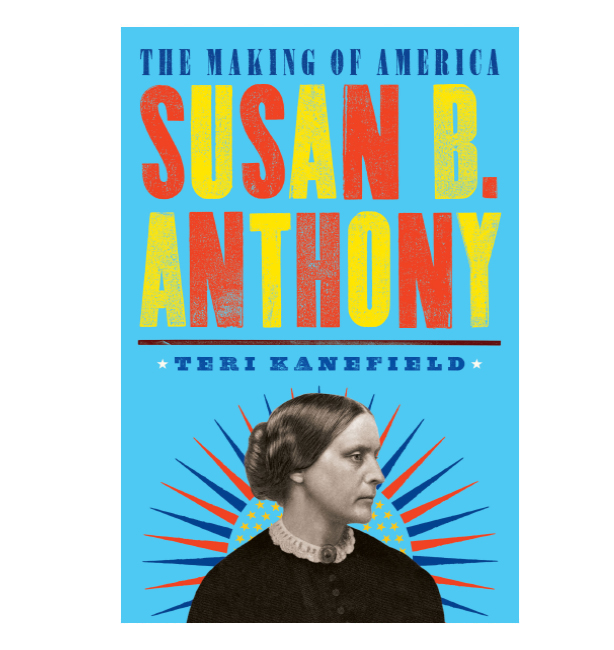
Susan B. Anthony was born in 1820 into a Quaker family. She always embraced Quakerism and its ideals. Quakers held the belief (considered radical at the time) that all people are equal. One scholar, Kathleen Berry, describes Susan B. Anthony as a “radical egalitarian,” which explains her life choices, even those choices that got her into trouble.
Quaker egalitarian ideas got them into trouble in England because they didn’t accept the hierarchy of king and aristocracy. In the United States, Quakers were among the early abolitionists. The Anthony home was a popular meeting place for local abolitionists. Frederick Douglass was a frequent visitor.
Quakers educated their daughters because they also believed women were equal to men. B. Anthony became a teacher, one of the professions open to women who could read.
At the age of 28, she left teaching to help her parents establish their farm. When the farm was established, her parents supported her work as a political activist. (The word then was “reformer.” That’s what they called themselves, that’s what she called herself.)
She spent the decade before the Civil War dedicated to women’s causes and the abolitionist cause. In 1856 she became an agent for the American Anti-Slavery Society. She drew a small salary that covered her travel expenses as she toured around and gave lectures, speaking against the evils of slavery.
At the time, this was dangerous. She had things thrown at her. Angry enslavers burned her Effigy.
She also developed a lifelong partnership and friendship with Elizabeth Cady Stanton, who was also dedicated to both women’s rights and abolitionism.
Let’s back up and talk about the situation for women in the nineteenth century.
A woman had no identity separate from her husband. The legal term was coverture. Wife-beating was legal. Divorce wasn’t an option. A woman couldn’t own property or enter contracts. A man had to speak for her. Any money a woman earned belonged to her husband. A woman was considered incompetent to testify in court. This is partly why she couldn’t get divorced or assert any rights. A few low paid professions—like factory or domestic work—were open to her, and teaching for women who could read. A man, on just his word, could have his wife committed to an asylum. Women who were “difficult “and refused to be subservient often found themselves locked in asylums.
It was obviously worse for Black women. Even after the Civil War, rape of a black woman was generally not regarded as a crime.
Susan B. Anthony never got married. When asked who she never married, she said it was because a woman in a marriage was not equal to her husband under the law, and she couldn’t abide any social situation where people are not equal. She phrased it this way: “Woman’s sustenance is in the hands of men, and arbitrarily and unjustly he exercises his power over her.”
Remember, at the time the Republican Party was the more liberal party. After the Republicans in Congress passed the Fifteenth Amendment, giving the vote to black men, the situation looked pretty hopeless for the cause of women’s equality. The Fourteen Amendment Section II, also one of the Civil War amendments, specified that women were not counted. It included the word “male.”
Representatives shall be apportioned among the several States according to their respective numbers, counting the whole number of persons in each State, excluding Indians not taxed. But when the right to vote at any election for the choice of electors for President and Vice-President of the United States, Representatives in Congress, the Executive and Judicial officers of a State, or the members of the Legislature thereof, is denied to any of the male inhabitants of such State, being twenty-one years of age, and citizens of the United States, or in any way abridged, except for participation in rebellion, or other crime, the basis of representation therein shall be reduced in the proportion which the number of such male citizens shall bear to the whole number of male citizens twenty-one years of age in such State.
When the text of the Fifteenth Amendment was being debated, Susan B. Anthony engaged in heated discussions. Both Anthony and Cady were enraged that women were not included in the right to vote. Both women understood that, just after the Civil War during this brief window, the Republicans had the power to push Amendments through. It was a narrow window when the constitution could be easily amended by the more liberal party.
When the text of the Amendments was being debated, Stanton said, “If that word ‘male’ be inserted in the Constitution, it will take us at least 100 years to get it out.”
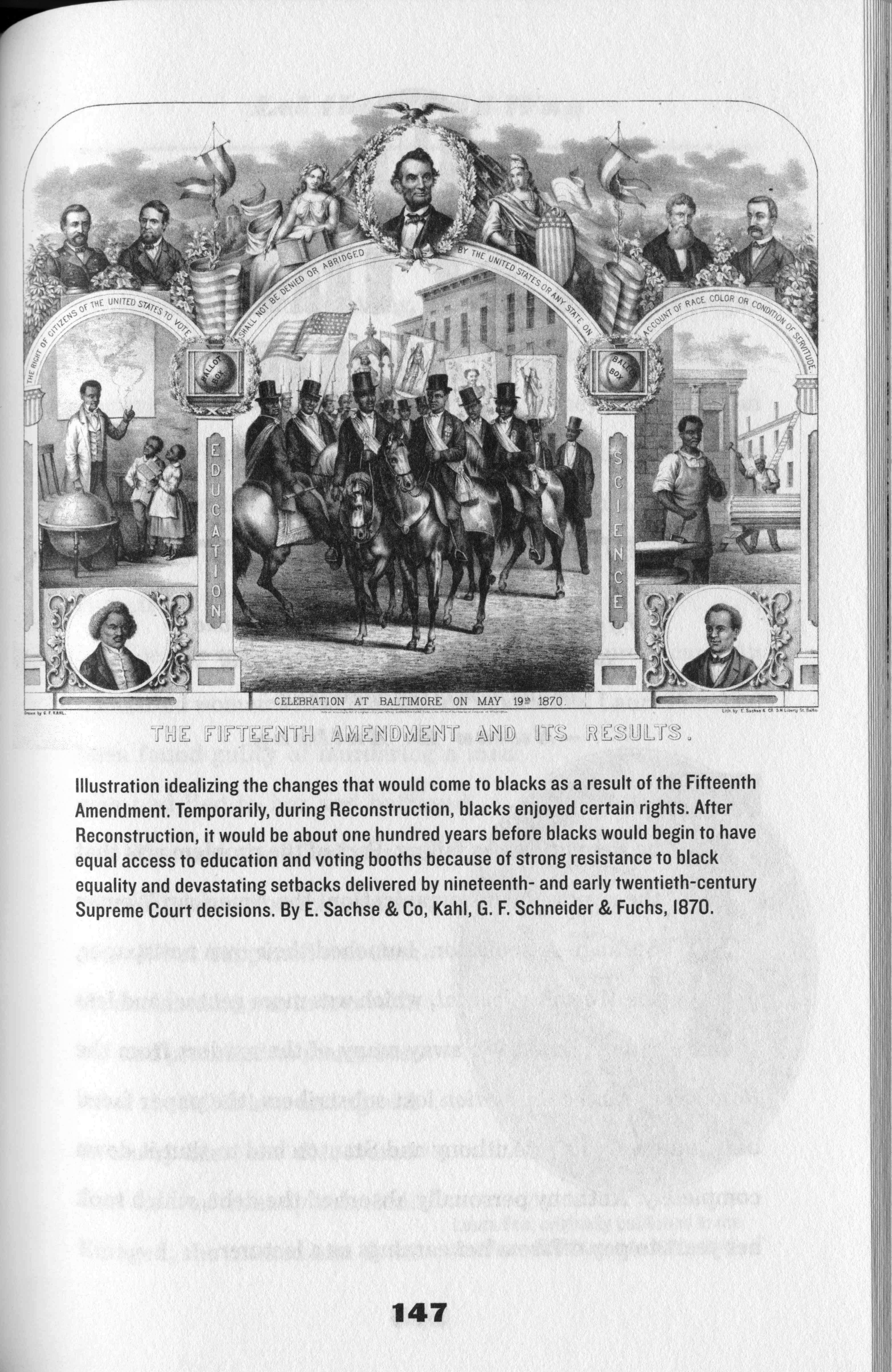
The Fifteenth Amendment was added to the Constitution in 1870. The Amendment gave the vote to Black men. Women were left out.
To say that Susan B. Anthony and Elizabeth Cady Stanton felt betrayed by the men who they had been working alongside for racial injustice would be an understatement. They had angry cross words. Anthony and Cady said that leaving out the women was a betrayal of the women who had worked so hard for equality for all people.
Not long ago, a teacher in an all-girls high school in San Francisco asked me if discussed in my book the fact that Susan B. Anthony was a racist.
I was shocked. Susan B. Anthony was a radical egalitarian and one of the first abolitionists. She risked her life for Black freedom.
I pushed back. The teacher dug in and said, “What about all those things she said about Black men while the Fifteenth Amendment was being passed?”
I suggested that the teacher read Chapter 9 of my book. If you’re curious about how a rumors of racism got started, here is Chapter 9.
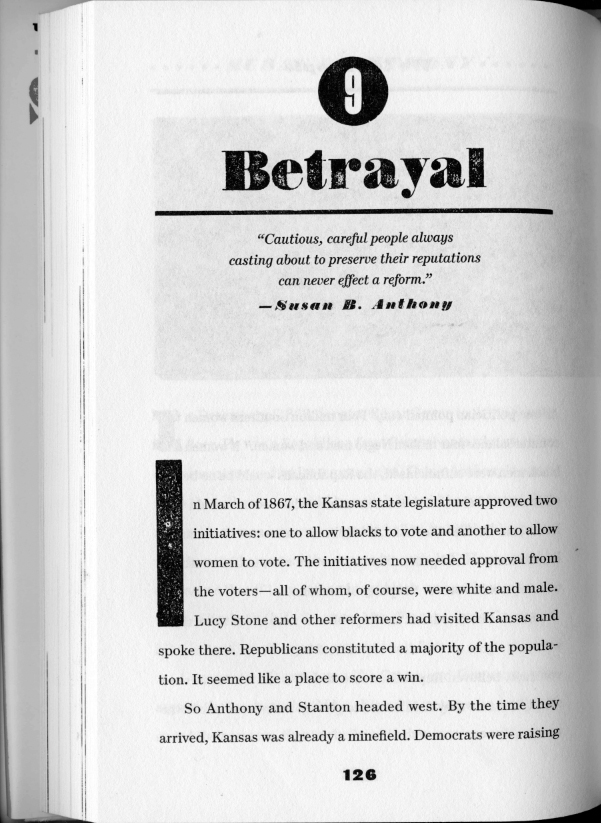
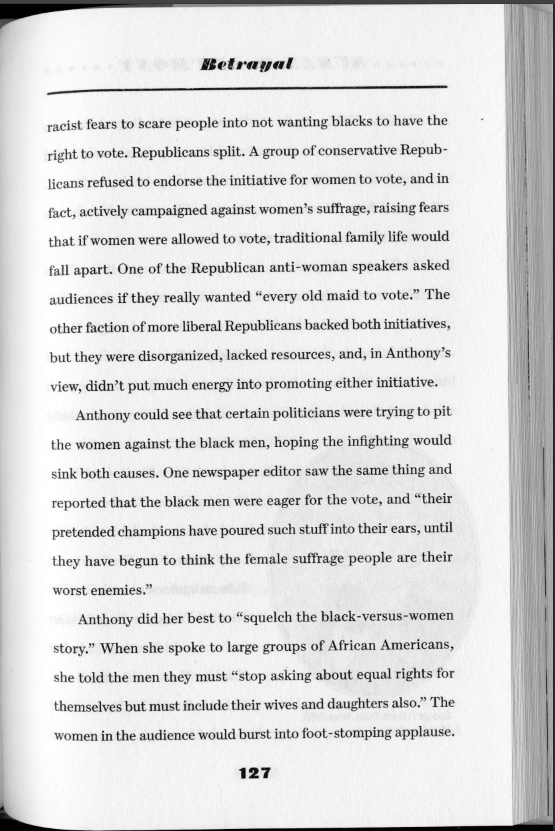
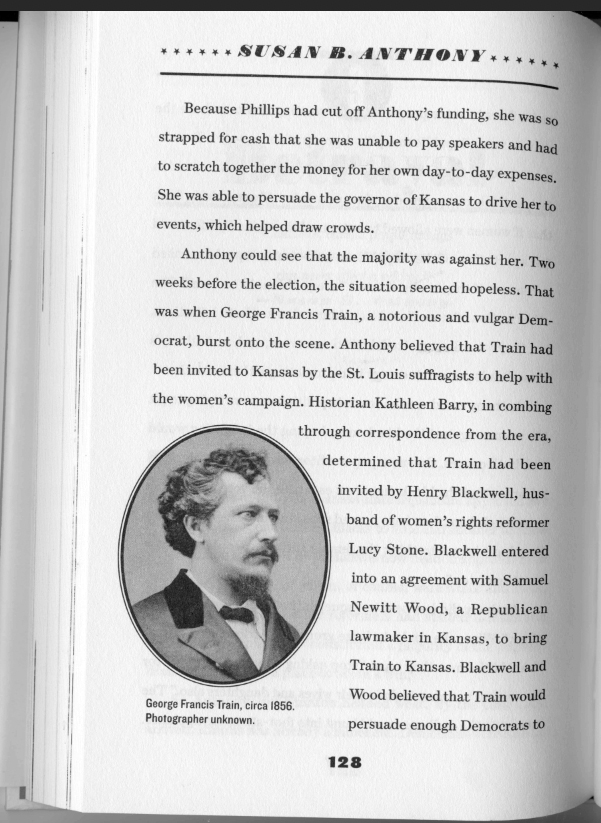





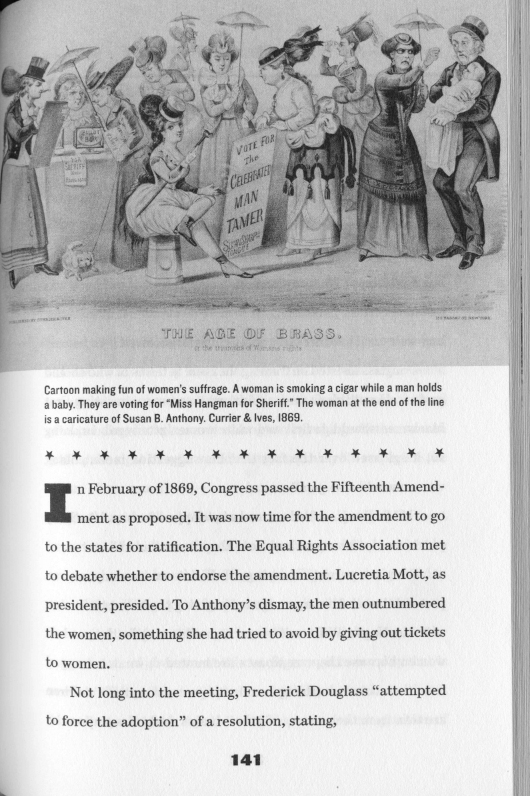



After the Fifteenth Amendment was added to the Constitution, the women reformers split into two groups. The more radical group was led by Susan B. Anthony and Elizabeth Cady Stanton. They took up for poor female factory workers. They worked on changing laws that kept women legally inferior to men. As before, Susan B. Anthony traveled and lectured. She knocked on doors and tried to talk to women about their rights. Many told her they had all the rights they wanted; they didn’t want equal rights and slammed doors in her face.
In her words, she’d “embarked on an unpopular case and must be content to row upstream.”
How did she keep going? She told herself she was working, not for her contemporaries, many of whom would never appreciate her work, but for “future generations we must labor.”
Occasionally, after making progress (like getting the NY law changed so women could own property) another group of lawmakers would undo their progress and they’d have to start over.
By the end of Susan B.’s long life, she did see some progress. In some places, women in abusive marriages could obtain divorces. Women were entering colleges. There was a nationwide (and international) women’s organization fighting for suffrage.
Susan B. Anthony did not live to see the passage of the 19th Amendment, which gave the vote to women. As an elderly woman, she wrote this: “Oh, if I could live another century and see the fruition of all the work for women!”
I guess mortality means none of us ever really get to know how the story ends.
When Susan B. Anthony became elderly, she trained young women in the organization to take over the work after her death. She called them her nieces. They called her Aunt Susan. She died in 1906 and the 19th Amendment giving women the right to vote passed in 1920. I included this image in my book.
After voting for Hillary Clinton in 2016, women flocked to Susan B. Anthony’s grave to pay their respects:

Of all the books I’ve written, the biography of Susan B. Anthony is my favorite. I cried writing the ending.